Traveling to the places she loves is an important source of happiness and inspiration for Petite Marie. She has several places around the world where she feels a deep sense of belonging: the ocean in Portugal, Vienna and its rich artistic and cultural life, Munich and its vibrant energy, and Istanbul, with its layered history and the restless pulse of a vast city.
She continues to discover new destinations, but always feels the need to return to the places that have become meaningful to her. For Marie, belonging is not necessarily tied to a single place. Instead, she feels as though different parts of her exist in different corners of the world – as if she belongs to several places at once, or, perhaps, as if these places have come to belong to her.
Marie says she no longer has hobbies in the traditional sense, as the activity she once considered a hobby has eventually become her profession. What she still deeply enjoys, however, is the art of slow living: spending time in cosy cafés, taking in beautiful surroundings for hours, staying by the sea all day, watching the movement of the water and listening to the sounds carried through the air.
For her, these quiet moments are a form of freedom. They bring her happiness, slow down the constant movement of her thoughts and give her mind the space to breathe.
Alexandra Bene: Marie, tell me about your journey.
Marie: I first came to Sibiu at the beginning of the war. My uncle had a colleague who was from Sibiu, and he invited my family and me to stay with his family for a while. At the time, I had no idea how long the war would last. I thought we might stay for a month, but in the end, we spent two months with this Romanian family in Șura Mică.
As the reality of the war became clearer and we realized it was going to last much longer, we decided to settle in Sibiu for the time being. We had already made friends here, and I also felt inspired by the city. From the very beginning, I saw a great potential for my work here because Sibiu is such a picturesque place. So we rented an apartment and started a new life.
Alexandra Bene: You were saying that Sibiu is an inspiration for you and your drawings. What are your main sources of inspiration, and when did your passion for drawing begin?
Marie: It may sound a little banal, but I have been drawing since childhood. I was always drawing during school lessons and later at university, mostly as a way to relax and clear my mind. I loved copying illustrations from books, especially fairy tales and children’s books, and I also used to draw portraits of my family members. It was the kind of thing any child or teenager might do.
At that time, however, becoming a professional artist did not seem like a realistic career option in my country. I never really considered turning drawing into a profession. It was simply part of my lifestyle, something I enjoyed doing, much like someone else might practise a sport.
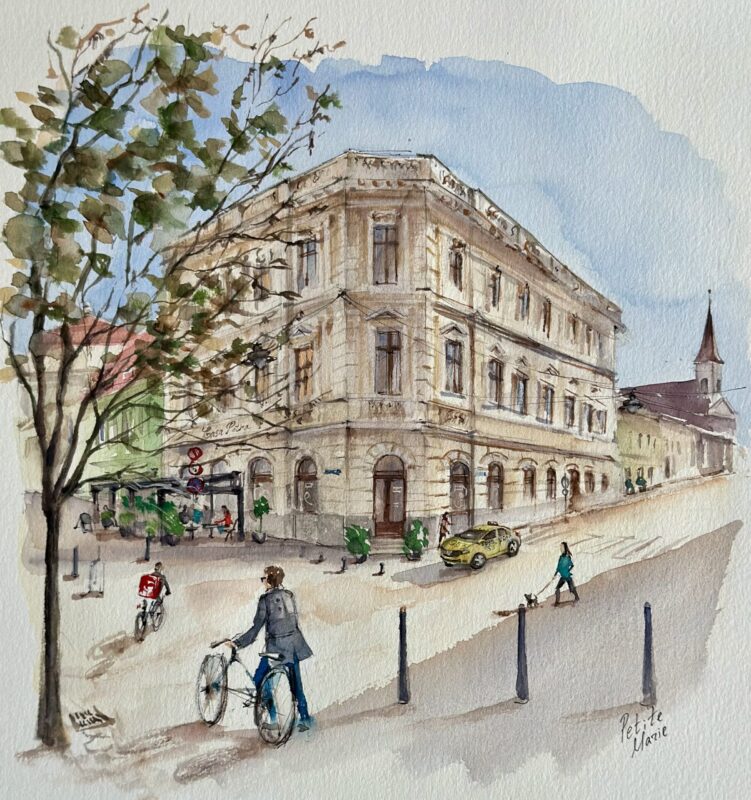
After finishing school, I went on to study something I considered more stable: management and economics. But after graduating, I decided that I wanted to take a painting course. I had always dreamed of learning how to paint in oils, so I finally went and learned.
Even then, I never imagined that I would actually work as an artist. Painting was still something I did for myself, almost like a sport. I started taking it more seriously when I was around 25. I’m 36 now, so that was about eleven years ago. That was when I began studying painting more professionally: learning the principles of oil painting, academic drawing and artistic anatomy, particularly in order to improve my portraits.
I also started making portraits at art school. Somehow, people were always giving me positive feedback and telling me that there was something distinctive about my work. My teachers would tell me that I had something special, and I heard the same from people around me who saw my art. Many of them encouraged me to make a career out of it, but I never really took the idea seriously.
Later, when I was living in Istanbul, there were many more opportunities and a much larger community of people interested in art. The same thing happened there: people kept telling me that I should turn my art into a profession. I received my first commissions in Istanbul, and that was when I realized that it was actually possible to earn money from my work and that people genuinely appreciated what I was creating.
That gave me the confidence to start selling my art. At first, I sold it for very little because I was still quite insecure about my work, even when it came to selling it in my hometown in Ukraine. So I kept selling, but it was still essentially a hobby – only now it was a hobby that had started to bring me an income.
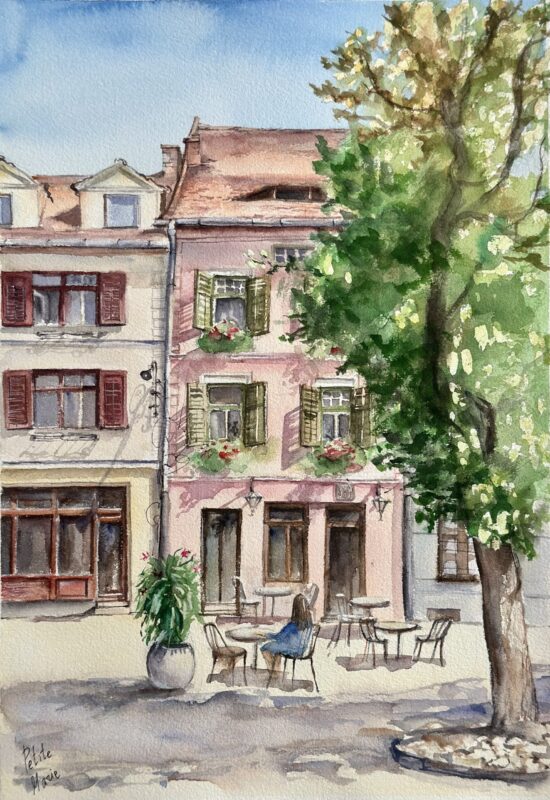
I think my real life as an artist began here, in Sibiu. I was deeply inspired by the city’s picturesque atmosphere, its architecture and its cafés. The cafés here are particularly special to me – their umbrellas, their views, the way they fit into the streets. Every European city has cafés, of course, but there is something about the ones here that feels unique to me. I can’t quite explain why.
And then there is the sunny weather, which allows people to spend so much time outside, sitting on terraces. All of these things have become important sources of inspiration for me in Sibiu.
Alexandra Bene: You mentioned that you eventually started selling your art. If someone wanted to buy one of your illustrations, how could they find you? Where can they see your work?
Marie: My postcards are probably my biggest form of promotion. They are available in bookstores in central Sibiu, where they are easily discovered by both locals and tourists. The postcards feature my paintings, so they are essentially small, accessible pieces of my work. Each one has a QR code leading to my Instagram account, where people can see more of my art and get in touch with me if they would like to commission something.
I also take part in festivals and cultural events in Sibiu, which have been wonderful opportunities to meet new people and find clients. Instagram is particularly important because it allows me to share not only finished works, but also sketches from places I visit. I especially enjoy drawing in cafés, so whenever I travel, I often make a sketch there and post it, tagging the location. Sometimes café owners will then get in touch and ask if they can commission one of my sketches for their space or use my work for promotional purposes.
So, I would say Instagram is the main place where people can find me, along with word of mouth. Many of my clients recommend me to their friends, who then reach out directly.
Alexandra Bene: I would also like to ask you, if you feel comfortable talking about it, how the beginning of the war affected your life and how you managed to cope with it while settling in Romania.
Marie: I would say that the war affected me primarily on a psychological level. It was an enormous source of stress for everyone. Fortunately, for me, the physical act of moving to another country was not the most difficult part. I had travelled extensively before the war, I had lived in Istanbul, and I was always interested in different cities and cultures. I was already quite accustomed to moving between places and adapting to new environments.
The real trauma was seeing the war happening outside your window. Seeing the bombing and knowing that you might not be safe, that you cannot be certain you will be alive the next day – that was the most difficult part. That uncertainty was ultimately why my family and I decided to leave. And we chose Sibiu because we were invited here by people who were already close to my family, so we were not arriving among strangers.
We also felt very supported when we arrived. In the beginning, Romania provided significant assistance to Ukrainians, including support for accommodation and basic needs. We never felt that we had simply been left to survive on our own. Romania, together with the European Union, offered us a safe place when we needed one.
Today, I feel that I am living a normal life again, much as I did in my hometown. I no longer feel like a foreigner here. In fact, I felt welcomed almost from the beginning. People responded very warmly to my art, I made friends quickly, and I found a community that supported me.
That sense of belonging was very important, but so was the inspiration I found in Sibiu. I can simply walk into the city centre, look at these incredibly beautiful buildings, and, for a moment, forget the things that used to haunt me. In that sense, the city has become a kind of meditation for me – a space where I can recover psychologically.
And the appreciation I received for my work also played an important role. Being able to create, to share my art and to see that it resonates with people helped me heal and regain a sense of normality.

Alexandra Bene: You recently said that you now consider yourself a full-time artist. What does that mean to you, and how does it feel?
Marie: It feels like a dream come true. I feel genuinely happy, and, for the first time, I can say that I am truly proud of myself. Sometimes I even think that the person I was before becoming an artist would be jealous of who I am today.
Alexandra Bene: Was it a long process? How would you describe the journey?
Marie: It was a long process, and I have to mention the people who believed in me along the way – my friends and all those who encouraged me, little by little, to believe that I could become not just an artist, but a successful one.
I never really saw that potential in myself. Other people did. They kept encouraging me, and for a long time I thought they were simply saying these things because they cared about me. This was particularly true during the war, when I was going through a difficult period and perhaps needed that encouragement more than ever.
But then I started receiving support from people in other countries, people who had no personal connection to me and who genuinely appreciated my work. They would tell me, again and again, that my art was good and that I should pursue it seriously. At some point, after hearing it often enough, I finally started to believe them.
And once I began to believe in myself, things started to change. The success came gradually, step by step.
Alexandra Bene: Many artists, particularly here in Romania, have the feeling that their work is not sufficiently valued. Public funding for culture and the arts is very limited, and it can be difficult for artists to make a living from their work. What is the situation in your country, and how has it been for you here in Romania? Do you feel that you can sustain yourself through your art?
Marie: I would say the situation is similar in my country, perhaps even more difficult. There is very little appreciation for art, and artworks are often sold for very low prices. People tend to underestimate their value.
As for artists themselves, I think that, in the beginning, you don’t necessarily need a great deal of money to invest in your work if you are truly committed to it. I was also afraid to invest too much because I thought: what if it doesn’t work out? What if I spend all this money and then lose it?
So I started with very inexpensive materials. My philosophy was that, if you really want to make art, you have to begin by doing it for yourself, without expectations, without assuming that people will immediately support you, and without making your survival dependent on it. You have to create because you feel that you have no choice – that it is something essential to you.
This is what I have experienced, and it has shaped the way I think about the relationship between artists and the world around them. I see many artists complaining about funding, governments and the lack of support for culture, and I understand those frustrations. But I also believe that the artist has to be the first person to inspire and support themselves.
You cannot expect everything to come from outside. If you don’t believe in your own work and support it yourself, nobody else will do it for you.