An interview by Andrei C. Șerban
Translation: Maria Dan
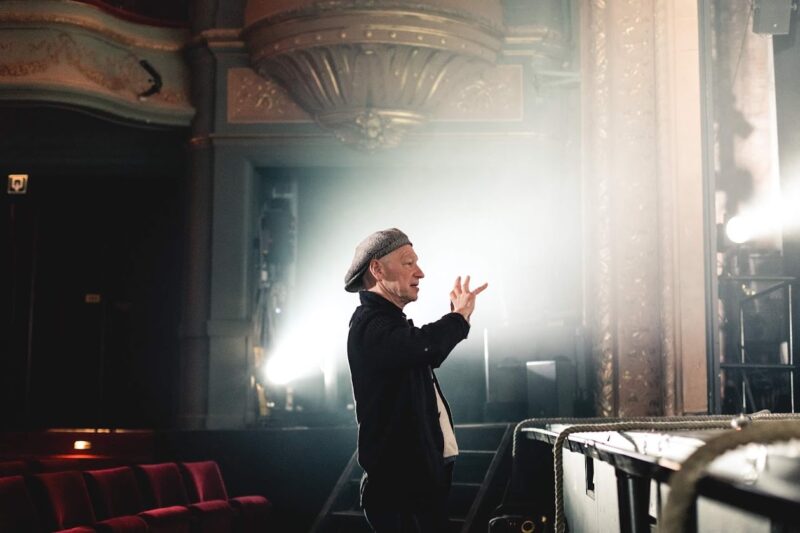
Luk Perceval belongs to that rare family of creators for whom theatre is, above all, a way of approaching what remains vulnerable and contradictory in the human being. The universe of his productions is immediately recognizable: austere, concentrated, sensorial, freed from ornament, yet crossed by an emotional intensity that is difficult to mistake for anything else. For Luk Perceval, theatre doesn’t need to pursue the spectacular. What truly matters is the presence of the actor, the shared breathing of stage and audience, the silence that can sometimes say more than the text itself.
His return to the Sibiu International Theatre Festival in 2026, with the performance Sex, Money & Hunger, opens a new chapter in the dialogue the artist has developed with FITS audiences. Inspired by the universe of Émile Zola, the production brings to stage the raw forces that shape existence: desire, money, hunger, the struggle for survival, but also the fragile possibility of compassion. At the same time, the encounter with Luk Perceval takes on a special significance for Sibiu – the Belgian director is preparing an important premiere at the “Radu Stanca” National Theatre, inspired by The Brothers Karamazov, one of literature’s great meditations on guilt, faith, freedom, and the abysses of the human soul.
The interview that follows is, in fact, an invitation into his artistic laboratory: a dialogue about theatre as meditation, about the actor as a human being exploring their own fragility, and about art as a space in which the darkness of existence can be contemplated without cynicism, with lucidity and tenderness.
Over the years, your productions have developed a highly recognizable stage language: austere and sensorial, poetic and violent. Looking back, do you feel this language emerged from a conscious artistic search, or rather from a form of resistance to the theatrical conventions you encountered?
Yes. But, after forty years, this question requires nuance. So, is my theatre language the result of years of revolt? I would say partly yes and partly no. You should know that I began as an actor and had no training as a director. During the first ten years of my career, I played many major roles, but I was often frustrated and unhappy with the directing. That is how I began to think about what a director should do and how a director should work.
I first experimented with directing methods as a teacher at theatre school, and during the first ten or fifteen years of directing I continued those experiments, developing and discovering my own language. Of course, that language had a lot to do with my discontent with theatre as I knew it — in my view, it was too intellectual, too conceptual, and what I missed above all was attention to the human being. To put it simply: I am not interested in actors acting like actors. I am interested in human beings, and in how we try to survive and find peace in life. More and more, I started focusing on making the actor more human and developing methods in that direction.
When I was thirty-five, I also had a major crisis, physically and mentally. I had started my own company at around twenty-six, and at the beginning there were no subsidies, so I had to generate the income to pay people. That created enormous pressure. Later we received subsidies, but even that was not enough to pay the team and the actors adequately, so we had to succeed; we had to make successful productions. That led to an enormous physical and mental crisis, and I ended up in the hospital.
I started doing yoga because a doctor warned me: “You have to do something, because smoking cigarettes and drinking coffee will not keep you alive, certainly not in the theatre.” So, I had to change my life. Through a friend who was a yoga teacher, I discovered yoga, what it did for me, and the spiritual path it opened. I became increasingly fascinated by spirituality and by the spiritual dimension of Shakespeare, but also of Dostoevsky, whom I am staging now at the National Theatre in Sibiu. That led me more and more toward leaving out nonsense, leaving out commentary on society, leaving out the ego of the director, and focusing on the nakedness of the actor, on the nakedness of the human being. I wanted to be touched, to be fascinated like a child; and I am still, like a child, fascinated by human beings. That led me to an aesthetic of bare spaces, where the actor is at the centre, or rather where the human being is at the centre.
For me, theatre became more and more a kind of meditation, a space in which the audience can focus completely on the human being, without random distractions, like videos or theatrical tricks. By random distraction I mean anything that does not lead toward the bare presence of the actor. This has been the result of forty years of work and of coming closer to my own essence. And that essence, as I said, is the human being: how we function, how we are driven by fear, by what is lacking in life, and by our inability to be in the here and the now. We are constantly chewing on the past and the future, constantly dream-walking, unable to live in reality and with reality. You could ask whether this is political; in my opinion, it is very political, because politics begins with our own egocentric feeling of being isolated and our need for borders, armies, and weapons.
For many theatre directors, literature is just a pretext for performance. In your case, however, there seems to be a profoundly organic relationship between stage and literary text, especially the novel, as if theatre were trying to extract not only the story, but also the atmosphere, the inner temperature of that novel. What is it that you continue to find in great literary constructions that still challenges you after so many years? And why do you feel that the novel remains such fertile territory for theatre?
The main reason I like to work with a novel is that it allows me to be more of a creator. A theatre text is always fixed, with its first, second, and third acts, its scenes, its follow-up, its characters, and their lines; it is already strongly determined by a playwright. What I like about working with a novel, apart from the fact that I think there are more good novels than good theatre plays (of course there are good theatre plays, but only a few very good ones) is that I can work with it like a sculpture. For me, a novel is like a block of clay. I can take it apart and start to form it according to my creative needs and my affinity with the novel, because a novel always needs transformation for the stage.
The stage is a completely different medium from literature. Literature has to describe everything; the stage has the strength to suggest and therefore needs fewer words. So, the first question is: which words do you cut away? What do you cut away from the novel? There begins an enormous creative process, which gives me the feeling that I am recreating, as an author and as a composer. I need to create a rhythm, a space, and a rhythm within that space. It also gives me the possibility to invite the actors to create with me. When you take a novel, everybody has a very specific reading of it, so actors also come with proposals: things to cut away from my proposal, or things to add to it. In that sense, working on a novel is much more collective.
Another thing is that you can present a novel on stage in a way that offers a very specific reading, one that other readers might not have seen before. That is the joy of working on a novel. I notice now, for example, that there are several theatres asking me to make a proposal, and I am much more attracted to taking novels and searching in literature than to taking another play. Most of the time, when I am asked to take a classic play, it means going back in time, to Chekhov, Shakespeare, or Aeschylus. Even then, these texts were written in a specific theatrical and historical context, so they also need to be adapted for today. That is also part of my joy in working on a novel.
Audiences today have another way of watching because they have been trained by advertising, television, and film. More and more, what you see in film is a completely different dramaturgy from films of twenty or thirty years ago, which were still edited with an introduction, then a plot, with a beginning, middle, and end. Today people watch Netflix films where the dramaturgy starts immediately in the fire of the action, the introduction comes much later, or different timelines are cut together. We are increasingly used to thinking much more associatively than twenty or thirty years ago, and that requires another kind of dramaturgy. That is also what the freedom of working on a novel, on a raw text or a raw volume of text, gives me. It gives me the possibility to decompose and recompose. That is an enormous joy, because it gives me the feeling not only that I am a theatre maker, but also an author and a composer. For me, joy is the essence of my profession: to find joy in what I do.
A large part of my life is my profession, and I want to feel the joy of creating. That joy is much greater when I start from the bare, raw text of a novel, try to find its essence, and transform it for the stage in collaboration with my whole team. From the moment we start to adapt a novel, everybody brings a specific reading, specific darlings, and a specific perspective. In collective work, this creates much more interesting discussions about the material than when you are simply doing a play, where the discussions are often limited to the psychology of the characters or the logic of the situation. A novel usually has a much bigger dimension.
You have returned to Émile Zola at several moments throughout your artistic journey. There seems to be something almost inevitable about this return. What kind of truth about human nature do you find in his work? And how is that truth transformed when filtered through contemporary sensibilities and through the body of today’s actor?
First, my affinity with Émile Zola is, on one level, very simple: it has biographical reasons. My grandfather was a miner. He started working in the coal mines when he was fourteen and died at fifty from the dust that got into his lungs. I was too young to know him, but when I hear my father’s stories about his father, they remind me a lot of what Zola describes in Germinal, and more generally of poverty. My grandfather’s wife ran a café where the workers came together and where the first socialist meetings took place, so it was also a kind of forbidden place in Catholic-influenced Belgium. That is the biographical aspect, and also the conviction that we are all more or less children of workers who were abused during the Industrial Revolution.
Another thing is my sympathy for Zola as a kind of embedded author. He lived among these workers and tried, like Darwin, to answer the question of whether humanity is on its way to becoming better, or whether the world is becoming worse and worse. That is relevant today, because it is a question we all ask ourselves in the world we live in: where are we going with climate change and with war zones? Actually, we live in a constant war. As far as I know, there are approximately one hundred wars going on worldwide, and we know about only three or four of them. So, this question fascinates me, and many of the people I meet today ask it too: where are we going? How is the world evolving? How is humanity evolving?
That is what interests me in the twenty novels written under the title Les Rougon-Macquart. I have chosen seven works from it because, thematically, I find there a kind of logic that Zola researches in his novels, and for which he is also one of the characters. Dr. Pascal is clearly a reference to Zola himself. The main character of Dr. Pascal is, you could say, Zola: a doctor whose goal, like Darwin’s, is to study his family and find out why there is so much suffering in the world, and what might bring an answer to the question of whether we can find the key to happiness. That is one of my fascinations.
Another fascination is that, when he goes through this novel cycle, he actually discovers three basic needs in the brain (in the meantime, neuroscientists have also shown that our brain has three basic needs). The first is the need to unify, the need to connect. That is why the first part is called Sex, because this need to connect is expressed through sexual energy. The second need is the need to feel safe. That is the second part of the trilogy: Money, or “fric” in French. We all have this need for safety, and that is what drives the world between rich and poor, because the rich accumulate more and more wealth, certainly these days; but I think this has always been the case. It is a human aspect, it’s universal and timeless. Then there is the need to survive, and that is the third part: Hunger. From the moment people start to feel hunger, and this is explicit in the story of Germinal, they become beasts; they start to kill, to revolt, to become monsters, driven by this primal need to survive and to find food.
A final reason has to do with the chronology of these different Zola productions. The first production I made from these twenty novels was for the Thalia Theater in Hamburg. It was a show that lasted three days, seven hours in total. I made it shortly before the pandemic, and it had to be presented during the pandemic. It was performed so sporadically that audiences lost the connection between the parts. I was a little frustrated after this Zola marathon because the audience did not have the chance to see the connections in the family and the logic that Zola and I wanted to show in human behaviour. Out of that came the need to create a new production, and to present this story and this subject in one evening. I condensed and reworked the whole adaptation into a play that is now, I think, two and a half hours. That is the version that will be seen in Sibiu, presented with the Stary Theatre of Kraków.
Another aspect is that, when we talk about our grandparents or great-grandparents, we are talking not only about how they survived, but also about how capitalism started to control our Western world and what kind of brutal influence it had then, and still has today, on people’s private lives. The relationship between economics and private lives fascinates me most. It led to deep traumas, and these traumas are transmitted through generations. That is why actors today are still connected not only to these traumas, but also to the past in which they were caused. What is very sad and painful in Zola’s work is that those who were abused become the abusers, not only by abusing others but also by abusing themselves, because they are all addicted to money, sex, drugs, alcohol. In my opinion, addiction in the society we live in is something that connects us to generations far back in the past. That, in a nutshell, is what fascinates me about Émile Zola.
Even in its title, Sex, Money & Hunger speaks about the great forces that shape both society and human intimacy. In your theatre, desire rarely appears romanticized or idealized; it emerges instead as a raw, sometimes devastating energy. Do you believe theatre has a responsibility to expose these uncomfortable mechanisms of existence, even when they become difficult for spectators to confront?
Well, yes. I think it is our duty as artists to make art and not just think about entertainment. When you think about what art is, and about the examples we consider art, for me these include the paintings of Munch, the Norwegian painter who expressed in The Scream the enigma of human despair; Van Gogh, for example, with his cut-off ear; Kafka, Chekhov, Dostoevsky; poetry; Shakespeare; the ancient Greeks. Why are these works considered art? Because they are universal. And what makes them universal? They are expressions of the dark side of our existence.
Of course, we live today in a time that is constantly advertised. Wherever we look, there is advertising. We see perfect human beings, perfect bodies, perfect smiles. Politicians behave as if they were gods, while in sports, we see heroes. We are constantly confronted with idealized images of what it means to be human. At the same time, this creates an enormous depression around us, because people feel, in a sense, not good enough to reflect these images. We are all more or less caught between a total fear and a total desire to be free, and these two are constantly in conflict. This conflict causes doubts, uncertainties, feelings of unfulfillment, and so on. Although we are desperately searching for happiness, there is, at the same time, a deep depression and unhappiness in our society.
The only space where we can share these doubts, the only space where we can share the feeling of not being enough, is in the arts, and certainly in theatre. I always say theatre is a kind of church of despair. There we discover that heroes are, most of the time, losing heroes. Through this, we can connect not only with these human beings and develop compassion for them, but also develop compassion toward ourselves, instead of beating ourselves up because we are not good enough or because everything we do feels unfulfilling.
Theatre, literature, and art in general create a space where we can accept that life is a struggle, that we are all doing the best we can, and that maybe this is already enough: to recognize that we are good human beings trying to do our best. That, for me, is the essence of theatre. That is why I like to show the dark sides of life, the difficulties, the struggle with love and sexuality, because that is, in a sense, what we are all doing: struggling to survive.
There is also a particular attention in your theatre to rhythm and silence. Sometimes it feels as though music and the body express more than the text itself. How do you construct this kind of breathing, this kind of “score” for a performance? Do you begin with the text, with an image, with music, or with a certain emotional state that you then try to translate into stage language?
The way I start is actually always the same. I start in the morning with a mindfulness yoga session. That does not mean I ask actors to put their legs behind their necks and prove they are lean, flexible, strong, or that they have any particular physical capacities. Mindfulness yoga is a session in which you first connect with your breath and with the silence of the breath. By silencing the rumination in your head, you come into contact with what Buddhism calls your true nature: the nature that is there, steering the car, thinking, doing, guiding you through life without you being really aware of it. In the first hour of rehearsal, I try to bring everybody back to his or her intuition.
Then I start to work out of my own intuition. This hour of mindfulness yoga leads to a form of high concentration, because without concentration you cannot make theatre. Certainly, when you do a production like Zola, where so many people are involved, you need a common focus. That is what mindfulness yoga does in the morning: everybody is brought back to his or her pure essence, which is doing nothing.
Then I must say that I am most often fascinated by actors not acting, by human beings. In the beginning I try to minimize action. When I feel that energy is lacking, I provoke action to see what can come through it. When I see that this action leads to forced energy, I take it back and return to doing nothing, to see how something organic can emerge between these two extremes. That, for me, is the most important thing during rehearsals: when does it feel organic? When do I hear a text that is not recited, but spoken, spoken from the heart, from an emotion, from an energy? That is what I search for all the time. Sometimes that can lead to cutting text, because it is more powerful for an actor to stand still and say nothing, simply letting his or her opponent speak. Sometimes it is necessary to ask an actor to improvise the text, and to say: “It is clear that your character needs to talk, to push away reality, to push the adversary in a certain direction. So, talk, talk, talk, until you achieve your goal”. Sometimes I use a lot of words; sometimes silence is more powerful.
More and more, especially when I work in another language, as I did now with Zola in Polish, which I do not understand, and as I will soon do in Sibiu, working in Romanian, which I also do not speak, the musicality of the energy, the musicality of the scene, becomes my composition, my score. Rhythm is like the oxygen of a performance, just as light is the oxygen of a performance. Sometimes you have to make the space very bright, so that people can breathe deeply and relaxed. Sometimes you have to focus a very dark space on one spot, to give everyone a precise focus. Sometimes you have to dance the “Rambazamba” on stage to light up and refresh the air in the space. It is like composing a symphony, or a piece of music. B
ecause I love music, and especially jazz, I always ask actors to play jazz and surprise each other, not to repeat automatisms. Of course, we are all lazy human beings, and it is comfortable to stay with what we know. But the real adventure, the real tension and novelty during rehearsal, comes when you dare to stretch your silence longer than is comfortable, to speak too much, to do something or say your phrase at a moment when nobody expects it.
One of the tricks I use is what I call “rehearsing Italian”: simply saying the text very fast, without intention, without pauses, just to train the text. After yoga, that is the first step I take: going in fast-forward through the text, without intention, psychology, or situation. Repeating that a few times a day gives actors more freedom with the text. First, because they train it; but also because it is a kind of rough jamming with the text, in which you sometimes discover things and meanings that you would not have found by reading the text, learning it very precisely, and then trying to say it the way you think it should be said. I do this to cut out all the “shoulds” and to make rehearsal a kind of adventure of discovery for the whole group: not only for me, but also for the actors involved and those watching, so that everyone can see how many possibilities the material contains.
Finally, I love silence. I love sitting in the theatre and watching the stage when maybe a technician crosses to get a tool from the other side and then crosses back. Actually, nothing is happening, only something purely human, without the force of being acted or presented. This is one of the many things that play a role in the musicality and composition of my performances.
The actors in your productions seem to move through genuine states of existential exposure. Watching them, the audience has the feeling of witnessing something both deeply vulnerable and extraordinarily precise. How would you define your relationship with actors? And what do you ultimately seek in a stage presence?
I am always searching, as I said before, not for an actor acting like an actor, or an actor acting like an actor who is acting, but for human beings. What is essential to human beings – and this is opposed to how actors are often trained – is that we do not demonstrate our inner world. On the contrary, from the moment we start to understand how the world functions, we learn to protect our vulnerabilities. That means that, most of the time, we are lying, hiding, pretending, or keeping our dignity, even though we may feel completely miserable inside. I am fascinated by this lying, this pretending, this hiding, this effort to keep dignity, because when you get that, an actor becomes very recognizable and very sensual. What you see is a human being struggling with uncertainty.
To give an example, my first hero was James Dean, who actually did not like acting. He hid from the camera, and at the same time he tried to overcome this; you could even call it a handicap. This struggle to survive is something that always touches me deeply in every human being I meet, and it makes the human being very vulnerable, touchable, emotional. So, this is the path on which I try to lead actors. Sometimes, when I see an actor faking, I say: “I do not believe you”. As I said before, we live in a world that is so fake. Television is fake, advertising is fake, politics is fake, and now, with AI, it is increasingly difficult to recognize the fake from the truthful. For me, this is a very political thing in theatre. That is why I want the theatre to be truthful. I want to see real human beings on stage.
Most actors like that, because many of them are fed up with showing their tricks and everything they know. Of course, it is nice to use all the things you can do, but it is more human and more challenging to play with your secret. Your secret is always what you want to hide, what you do not want others to see: your vulnerability. That is what I search for in every actor: the secret. What is the secret? Do not show me how well you can expose your secret; show me how you can hide your secret, because that is where mystery begins. It makes me, as a spectator, guess. It makes me interested in this human being. That is what I ultimately seek in stage presence. That is also why I leave out everything that distracts on stage. I really want to see the actor, the actress, naked – not in the literal sense, but naked as a human being. I am more interested in the inner world of a human being than in the compensating behaviour of that inner world.
The audience of FITS has already encountered your work in different artistic contexts. This return inevitably creates a kind of emotional memory. How do you perceive the relationship between an artist and their audience over time? Are there festivals or places that become, in a subtle way, part of one’s own artistic biography?
Biography, certainly. I had the luck to be an artist in residence in different places for long periods. One was St. Petersburg, in Russia, where I was invited year after year with my performances to the Baltic House festival. Later that became Moscow; before that it was Munich, the Münchner Kammerspiele; then eight years at the Thalia Theater in Hamburg; and, of course, Antwerp, where I started. After a while, a very familiar relationship absolutely develops. What I discovered is that every city has its specific fascination.
My work, which is quite emotional, had a much stronger emotional response in Russia than in Germany, for example. In the beginning, that confused me a lot. I was invited to Russia; nobody understood the language of the performances I brought there, and yet the house was full. People left the theatre crying, speaking to me, asking questions. It was as if, for the first time, they had seen something they had never encountered before. I was very surprised by that. Afterwards, I realized that the emotion had a lot to do with the vulnerability of the actors, which in Germany is seen as something suspicious. I can understand that, because of Germany’s history, because of what happened during the Second World War: the loss in nationalism and fascism, the cruelty that took place in Germany, and the shock this left in the whole country. Germany has a kind of suspicious relationship with emotion, and especially with uncontrollable emotion.
I would not say this is absent in Russia, but what I experienced in Russia, and to a certain extent also in Poland, is that in Russia and in the more Catholic parts of Europe, living emotions are seen as a way to catharsis. This catharsis is strongly rooted in the religious tradition of Russia and Poland, and I suspect also in Romania, and certainly in Belgium, because Catholic religion is very much focused on finding catharsis through suffering. That is a very strong aspect of my work and of the themes of my work. On the other hand, in Germany people were very fascinated by my eagerness to experiment with theatre forms, and to find forms that did not try, as the German saying goes, “to give the monkey sugar” or revel in intellectual concepts, but instead went toward a kind of theatre of poverty, a pure form of theatre. So, these different cities and countries certainly created very specific and profound relationships with the audience, but because the cities were different, the relationships were also completely different.
Your theatre often creates the sensation of a world on the verge of social, emotional, and moral collapse. And yet, within this fragility, there almost always appears a strange form of tenderness or compassion. Is this one of the functions of art for you: to discover humanity even in the darkest areas of existence?
Yes. In my opinion, what connects us all is struggle: the struggle to survive, whether on a physical, mental, or emotional level. We are all, more or less, trying to survive, and this survival mode leads to struggle. As I said before, art is there to share this struggle, to create a space that gives people the feeling that they are not alone. Most of the time, the artist, the text, the actors, directors, theatre makers, and artists all over the world are sharing their very personal, individual vulnerability, whether it is irritation, anger, despair, or humour, which is also often a form of despair. It is very personal and individual, and that is what makes art art: the individual expression of a personal feeling, perspective on life, or experience of life.
This sharing gives people the possibility to feel that they are not alone in their struggle. From the moment we can create this feeling that we are all in the same boat, we do not need to have an answer. We may have many dreams and utopias, but we have no ready-made solution for this moment. We can only confess to each other that we are all struggling with the same fears, frustrations, anxieties, and so on. Gathering in a dark space like the theatre, being silent, watching the fate of characters on stage, recognizing your parents, recognizing yourself, connecting through recognition and accepting each other’s struggle – all this creates a space of compassion. And compassion and acceptance are among the things we need most today.
After decades of creation and artistic reinvention, what does the idea of “living theatre” mean to you today? What can the stage still do, in 2026, that cinema, literature, and the digital world cannot?
First of all, I would not put cinema, literature, and the digital world all in one heap. I would say that what cinema and the digital world cannot do is create a three-dimensional space. What is typical of cinema, for example, is that cinema has to make everything believable through images. To put it very simply: in a film, if someone says, “Oh my God, it is cold outside, I am freezing”, and by accident you see through the window that the garden is blooming, you no longer believe the film. When I was a young boy, we were always watching old cowboy movies and trying to catch a Native American wearing Converse basketball shoe, to prove that the film was fake. That says a lot about what cinema and the digital world can do. They are believable only when the images illustrate, one to one, what is being said or shown. In that sense, they are one-dimensional.
The sight is a sense that essentially checks. In our most primal state, we climbed into trees to see whether a dinosaur, an enemy, or another threat was coming and whether we had to flee. So, the eye is always busy with distrust, looking ahead to check whether everything is safe. Literature, music, probably poetry, and even the visual arts are art forms that need our fantasy. You can close your eyes while listening to music and imagine the world the music creates. In literature, you read characters on a white sheet of paper, and you constantly have to fill in, with your mind and imagination, the world these characters create. The same is true of poetry and, in another way, of visual art, which in its best form can be completely abstract and still create an emotion, a sense of being, or a space without being the real space. It does not have to illustrate.
The same is true of theatre. The force of theatre is imagination. You can stand on stage and say, “The woods of Birnam are coming toward me to kill me”. You can stage it without woods, in an empty space, and still see soldiers dressed as trees coming to kill Macbeth. You only have to say the words “father” and “mother” on stage, and everyone in the space immediately thinks of his or her father or mother. What makes theatre unique compared with other art forms is that the stage is a collective space. You are sitting there, sometimes with a thousand people, sometimes with fifty, and during rehearsals I may be sitting with ten people watching. This space becomes something from the moment everyone is actively focused and concentrated on what is said and done there. From the moment one person watches a phone or reads a newspaper – as I have experienced in some theatres, and that is why I forbid reading newspapers or looking at phones during rehearsals – the space is broken. But when everybody is involved, then, in what is not said but only suggested, a world appears, a universe appears. Sometimes it disappears because something is said too much, or without fantasy, without inspiration.
This space of collective fantasizing is more important than ever today because we are so overfed with one-dimensional spaces: television, our smartphones, billboards, and so on. Collective fantasizing not only creates solidarity; it is also important because it opens our minds to something beyond our own personal frustrations. It widens our view in space and time. We discover that people five hundred years ago, in Shakespeare’s time, or a thousand years ago, in the time of the Greek classics, had the same doubts. We are connected through time and space by the same basic emotions. That is why I like to tell stories that go back in time. It is one of the things that fascinates me about the Zola story: this connection, this feeling that I am not the only one, and not the last one. I am, in a way, part of a reincarnation of cosmic energy, and I have my time here on earth, which means I have my responsibility. With that responsibility, I can contribute to an awareness that we are more than this one body and this one emotion today; that there is something much bigger.
That is something I can sometimes feel in the theatre, though not always. I can feel it in a museum when I am alone, and I can feel it when I read a book alone, but I cannot feel it in the cinema, or watching television, or on my smartphone. The collective being, the gathering as a group, has something very ritualistic and primitive. It is like gathering around a fire, watching the fire, and beginning to tell each other stories, stories that say something about us and through which we can learn from each other and from ourselves. Maybe that is very old-fashioned and very primitive, but in my opinion, it is more than necessary today, because this world – it is a cliché to say it, but it is true – is driving us apart like madness.