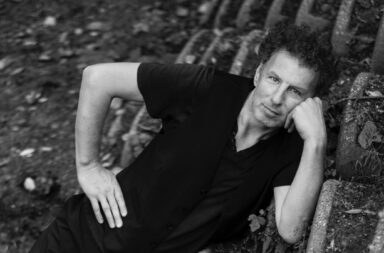
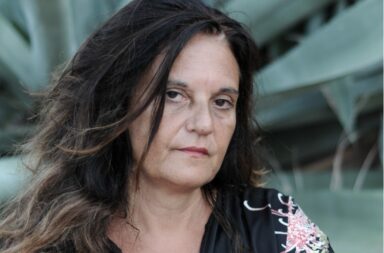
A star on the “Walk of Fame” in 2026 solidifies actress Ofelia Popii’s place among the great international artists associated with the “Radu Stanca” National Theatre and the Sibiu International Theatre Festival. Her recent move to the National Theatre Bucharest—making her debut on the “first stage” playing both queens in Mary Stuart—places her in the lineage of the finest traditions of Romanian theatre. Ofelia Popii views celebrity with the very modesty that fuels her passion for the stage, and our dialogue breathes this authentic honesty toward her art, which continues to refine itself through the alternating rhythm of her roles in both theatre and film.
Oana Cristea Grigorescu: You left Sibiu to settle in the capital in 2024 as a member of the Bucharest National Theatre company, where you are currently performing in three powerful productions: Mary Stuart, directed by Andrei Șerban; the controversial The Prophet Elijah, directed by Botond Nagy; and the recent premiere Of People, Doctors, and Rhinoceroses, directed by Claudiu Goga. What is the direction of your career now, and what has Bucharest changed in your relationship with the stage and your roles?
Ofelia Popii: Before coming to Bucharest, I performed at ARCUB in Someone Is Going to Come, a performance we are still running. In the meantime, we also have a co-production between Green Hours and the “Radu Stanca” National Theatre in Sibiu called You Can’t Feel It Here, by Lia Bugnar. Among my roles, Mary Stuart is important to me because of the reunion with Andrei Șerban. This was the main reason I came to Bucharest—and, of course, the sheer substance of the role and the challenge of portraying two characters in the same play. Right from the casting process, Andrei Șerban wanted the actresses to cover both queen characters, and he knew we would flip a coin to find out live, right in front of the audience, which role we would be playing that night.
I thought it was an excellent challenge. I had worked with Andrei Șerban in the past, in Sibiu in 2006 on The Seagull, and at the National Theatre in Cluj on Don Juan in Soho, though I played that role only briefly. I love that he is a courageous and incredibly free director. Essentially, I really wanted to experience working with him again at a more mature age, to see how I would approach that encounter now that I am a bit more experienced. I can honestly say I came to Mary Stuart for him, with no intention of staying in Bucharest. I hadn’t really made up my mind, but I realized afterward that it’s entirely possible to perform both in Sibiu and in Bucharest, where there are so many theatres, especially independent ones, where I can explore an artistic landscape I haven’t experienced until now.
Oana Cristea Grigorescu: Essentially, you encountered independent theatre in Bucharest at unteatru, where you have been performing since 2023 in studio productions directed by Chris Simion-Mercurian and Andreea and Andrei Grosu. These shows feature themes inspired by family crises, where the work on the character focuses on internalization and detailed performance—in a way, much like acting for the camera. What has the Bucharest independent scene offered you, and to what extent did these roles, along with your film castings, contribute to your decision to leave Sibiu?
Ofelia Popii: Yes, I started performing in independent theatre if we think of the show MASS at unteatru, which happens to be scheduled today at the theatre’s new venue. On the other hand, I am currently working at Grivița 53, where we will have a premiere directed by Botond Nagy—a stage adaptation of Michael Haneke’s Funny Games, which is by a powerful and provocative auteur and a landmark film on top of that. I became deeply interested in this realm of independent theatre because here, things don’t have the massive scale of large, powerful, and terribly demanding productions. Here, everything is filigree work; it’s a different kind of approach, perhaps more delicate, more nuanced, closer to the human element. And the presence of the audience is extremely close. The spectators sit right next to the actor; they are a living presence that you feel very intensely. We know that the audience is there in every show, but here you feel much more strongly that we are together in a communion.
Every single moment, second by second, they are right there with you, beside you. You feel them when they cry, you feel them when they want to laugh but don’t want to disrupt the moment. The audience is a palpable presence; you can’t pretend they aren’t there. You are more vulnerable because of it and, at the same time, more responsible. It is as if I were walking hand-in-hand with someone and guiding them through the entire experience of the role, through every situation. In small spaces, intimacy makes all the emotions much more accessible to the spectator than in a larger venue. Of course, this can happen in a large hall too—perhaps for those in the very first row. But there, the productions are designed to have a grand scale. Here, they are stripped bare, without too many images, without too much equipment or technical effects.
Everything relies heavily on the story, the actor, the emotions. Yet, on the grand stage, it is also terrifyingly challenging to perform The Scarlet Princess, where in massive spaces, it is extraordinarily demanding to reach the audience. It is an immense challenge to break through, to project thoughts and emotions across that space. It is equally demanding, though in the exact opposite way, when the person is right next to you. You feel even a single second in which they disconnect from the story. You feel everything.
Oana Cristea Grigorescu: Returning to your two major roles at the National Theatre Bucharest in Mary Stuart—how do you manage to step into character instantaneously, given that you only find out which of the two queens you will be playing at the exact moment the show begins?
Ofelia Popii: I don’t show up pre-set or prepared; rather, I am open and ready for anything, accepting whatever comes. Ever since I had this experience, I’ve used it in all the roles and all the shows I’ve performed since. It requires openness—at least, that’s how it is for me. Raluca Aprodu mentioned that it helps her a lot to arrive prepared for the role of Mary and then make the switch to Elizabeth if needed. Having that first segment available gives you time to connect to the character. For me, that method doesn’t really work. I’ve tried, but I noticed that it’s best to be in a “zero state” where I am ready for anything.
The moment the coin lands on one side or the other, that sudden flash of stage fright simply channels itself into the emotions and fear felt by Mary, who is the first to enter the stage, or into a sort of inner strength that characterizes Elizabeth more. It’s simply an internal switch that happens the moment the coin lands, which I don’t see very well anyway, because I’m nearsighted. I usually realize which role I’m playing based on how my colleagues lean in. I think I see it, but I never have absolute certainty. I’ve actually had moments where I thought I saw one thing, only to find out I was supposed to play the other role.
Oana Cristea Grigorescu: So it is total suspense until the very last second, adding an extra layer of emotion that gets you ready.
Ofelia Popii: You have massive stage fright before any show. Here, the emotion is triggered more intensely the moment destiny sets itself in motion…
Oana Cristea Grigorescu: What matters in the profiles of the two queens?
Ofelia Popii: For me, what matters immensely in the profiles of these two queens are both their common traits and their differences…