Realised by Diana Nechit
Emma Dante arrives at FITS 2026 in a moment of double significance: as the writer and director of The Angel of the Hearth / L’angelo del focolare, presented on June 26 and 27 at the Main Hall of the Radu Stanca National Theatre, and as an artist honored on the Sibiu Walk of Fame and during the Walk of Fame Gala. Her presence in Sibiu thus offers not only an encounter with one of her most recent creations, but also an opportunity to reflect on a body of work that has profoundly shaped contemporary European theatre.
Emma Dante’s artistic universe is built upon fundamental tensions: the family as a space of both love and violence, the body as a vessel of memory, marginality as a site of truth, dialect as a living force of language, and the fairy tale as an unsettling territory stripped of sentimentality. In her productions, reality is not reproduced but distilled and transformed into powerful images, rhythm, musicality, and confrontation.
The Angel of the Hearth opens a necessary conversation about domestic violence, the mechanisms through which abuse perpetuates itself, and the difficulty of escaping cycles that seem destined to repeat endlessly. It is a performance in which routine, silence, and death become the structures of a closed world, while theatre assumes the role of making visible what is most often concealed.
This conversation begins with Emma Dante not only as one of the most influential voices of contemporary theatre, but as an artist who transforms fragility, cruelty, and memory into theatrical language. The aim of the dialogue is to understand how these stage worlds come into being and what questions theatre can still ask today about the body, the family, violence, and the human condition.
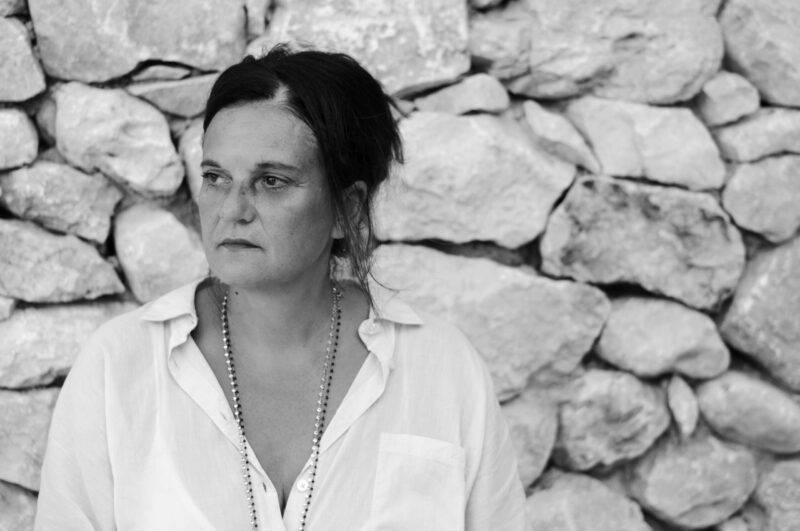
Diana Nechit: At FITS 2026, you are present both with Îngerul casei/ L’ Angelo del focolare/ The Angel of the Hearth and as an honouree on the Walk of Fame and at the Celebrity Gala. In the context of a festival that celebrates you through a work that turns domestic violence and femicide into a scenic mechanism of repetition, how does the relationship between recognition and artistic risk shift for you? What was the first concrete image from which this work was born?
Emma Dante: First of all, I am deeply honoured to be present at the Festival with my latest performance, and I am even more honoured to be celebrated as a personality on the Walk of Fame. Before anything else, I would like to thank everyone for this immense and wonderful recognition, and I am very sorry that I cannot be there in person. As for my journey as an artist, I feel I can say that, through my theatrical practice, I have always believed in overturning rules, in imperfection rather than virtue. I have always believed that a story brought to the stage must have something to do with revolution. For me, making theatre means rebelling against the system; it means rewriting new rules. And I am not afraid of failure. Never. Failure is part of the game; if it happens, it means that we needed to take that risk. I believe that theatre is still an important voice in opposing overly extreme principles, harsh prohibitions and prejudices that generate censorship, closure, and that right-wing way of thinking which increasingly dominates Europe and in which I have never recognised myself.
Theatre is a place of celebration and secular prayer, where celebration is not only entertainment, but also an opportunity for reflection and for sharing the pain and suffering of others — especially of the most vulnerable, of the unfortunate, of those who cannot celebrate with us. The Angel of the Hearth does not deal only with a theme. It speaks about a femicide, but also about a dysfunctional family in which there is an imbalance of power and a strong male domination. In this house, power is exercised between the man who trains his own ego and the frustrated woman, forced to endure in silence her husband’s abuse and commands. It is a family made up of roles: the wife, the husband, the son, the mother-in-law, precisely in order to describe, in symbolic terms, a state of affairs that continually generates conflict and suffering. There are still families, not only in Sicily, marked by this patriarchal predominance.
Families in which the patriarch may have disappeared only in appearance, while a patriarchal attitude continues to exist in every respect, with all family members entangled in it and complicit. The position of women in Italy remains precarious. There are many femicides over the course of a year, and their number does not seem to be decreasing at all. This happens because of a cultural problem, and it reveals a lack of emotional and sexual education within the family and the school system and, consequently, within society. The starting point of the entire project of The Angel of the Hearth was reading about yet another femicide.
Diana Nechit: In your interviews, the initial impulse for a work can come from an intimate experience, from observing a body, from an image glimpsed unexpectedly, or from music that begins, almost on its own, to produce scenes. How do you recognise today the core that is worth following? By what criteria do you decide that an intuition should be carried all the way to the final form of a performance?
Emma Dante: The creative method behind my way of making theatre, through the aesthetics of the body, is never detached from the reality of life and from the present moment. Actresses and actors, naturally endowed with a spirit of observation, learn to imprint in their memory everything that happens around them, so that they are able to choose and bring into focus the detail that an inattentive eye would usually miss. The aim is always to stimulate this kind of attention and readiness to listen, in order to develop one’s own authentic interpretation of the truth that is brought back to the stage through allusive codes. What interests me most is the authorship of the actor and the actress, who search within themselves for an authentic and unique voice. This voice has to do with gesture and movement. Body and word are always fused together.
In the case of the performance The Angel of the Hearth, we tried to bring to the stage the interpretation of certain violent gestures and postures within an ordinary context, such as the domestic one, where the ordinary ritual of any given day turns into the extraordinary ritual of the death of a woman killed by a man. In this family, the husband’s habitual violence against his wife turns into femicide. The man kills her by smashing her head with an iron. The woman lies on the floor, dead, but her death is not enough: no one believes her. And so the woman, like the “angel of the hearth” in whose grotesque image she finds herself trapped, is forced to get up and return to the same routine: cleaning the house, taking care of the domestic work, preparing food for her son and husband, looking after her elderly mother-in-law. Every morning, the family members find her dead and do not believe her. Every morning, she gets up again, opens the moka pot, makes the coffee, and the day begins again; and she begins again to endure her husband’s violence, her son’s depression, and the helplessness of her mother-in-law, who, instead of condemning her despotic son, pities him.
Every evening, the wife dies, as if in a circle of Hell where the punishment never ends. All of this is paradoxical and, in a certain sense, grotesque as well. In the performance, people laugh — but it is a bitter laughter. They laugh at a man who, with a lollipop in his mouth, turns his own penis into a display of strength, teaching his son that women are won over with muscles. They laugh at him because he is being ridiculed; they laugh at the son who feels completely inadequate; they laugh when the wife describes her husband as a troglodyte with an ungrammatical heart. But, I repeat, these are bitter laughs — laughs that hurt.
Diana Nechit: You have described opera as a passion that conquers you and, at the same time, as a territory full of constraints; you have also said that the music of a great opera can already suggest the staging. When you approach an operatic title, what do you stubbornly preserve from the freedom of your theatre, and what do you accept transforming in order to listen to the score? What does the music tell you before the libretto articulates meaning?
Emma Dante: As an initial impulse, I firmly believe that music and singing help people overcome the tragic moment of passing from life to death. Music helps souls ascend to heaven. I believe that a beautiful and necessary opera is timeless. It is a poetic work that speaks of human arrogance, deception, invasion and independence. A necessary opera already contains what happened in the past, what is happening today, and all the conflicts that lie in between. I do not like staging an opera in a documentary style. Current conflicts are certainly too complex to be represented in an opera. They change form very quickly, losing the immediacy of the moment. Poetry, instead, endures. It speaks to the heart and to the mind. The most important thing for me is that the people who watch and listen to an opera identify with the suffering and pain caused by the horror of the world, and that, in the end, they feel a strong sense of responsibility.
Diana Nechit: In your theatre, the body does not illustrate meaning; it produces it. Dialect does not function as simple local colour, but as a form of tension and a violent entry into the world of the performance. How do you build, in rehearsal, this grammar in which body, voice, noise, and dialect work together without hardening into a device? What can the body of the actor or singer say where the text can no longer reach?
Emma Dante: I start from a phrase by Pina Bausch, who said: “Dance, dance, otherwise we are lost.” Pina Bausch’s dance, which has nothing to do with mere choreography, was like the dance of life. I believe deeply in this quotation; I believe in the force of thought that sets the body in motion; I believe in travel, in movement, and I believe that growing means, above all, visiting other places, encountering other habits and traditions. Theatre has taught me this wonderful journey through the dance of life, where nothing can be taken for granted and where, at every step, one may stumble. Our dance is always in danger: from wars, from the ugliness of the world, from discrimination, from violence. And yet I continue to believe in the role of art as medicine.
The starting point of our training is always walking. Movement. By moving together in the same direction, we strengthen ourselves and become united with one another. Walking has always been the first discipline of my way of making theatre together with others. With my company, we have always walked — a great deal, for hours, for entire afternoons. Our main exercise was, first and foremost, to move in a straight line, back and forth, aligned, with the same rhythm, with the same breath. This exercise, which I learned from my teacher Gabriele Vacis, is called “schiera”— formation. The schierahas a political and social meaning: it is a way of moving all together in the same direction, of sharing a thought, an action. The formation creates family, creates community, creates morality, ethics, and a political stance.
Diana Nechit: In many of your creations, from Cinderellaand Rusalkato works crossed by fairy-tale or Shakespearean echoes, the fairy tale does not sweeten reality; it makes it more unsettling and more cruel. What does the fabulous register offer you today for speaking about violence, otherness, the feminine condition, and fragility in ways that pure realism could not reach with the same force? Where does the fairy tale end and the document begin in your theatre?
Emma Dante: I have always found in fairy tales something real and contemporary, something that belongs to us. What I like in fairy tales is the truth. Teaching and morality are two extremely important elements in the role that a performance must have, and the fairy tale contains these elements. The fairy tale teaches, punishes the wicked, rewrites laws according to ethical principles, and believes in a moral order. In every creative gesture of mine, there is always the need for narration. Even in opera, it is not enough for me to tell the story of the libretto; I always feel a strong desire to narrate my present, what I see and what I experience every day. Only through the dramaturgy of the contemporary is it possible to interpret fairy tales and return to our origins, to the little girls and boys who, with enormous patience, have remained waiting inside us.