Interview by Andrei C. Șerban I Translation: Maria Dan
What is the future of theatre in a public sphere saturated with noise and suspicion?
Norwegian director Tore Vagn Lid starts precisely from the need to rethink the stage as a place of trust. For him, analogue theatre rediscovers its strength precisely through what new technologies cannot replace: physical presence, interpersonal communication, collective concentration, and the shared experience of a concrete situation.
A Norwegian director, playwright, composer, and researcher, Tore Vagn Lid is one of the European artists for whom theatre remains a space of critical investigation and political reflection. Professor of dramaturgy at the Norwegian University of Science and Technology, he works at the intersection of literature, music, documentary material, and research, creating performances in which the archive is transformed into a living theatrical experience.
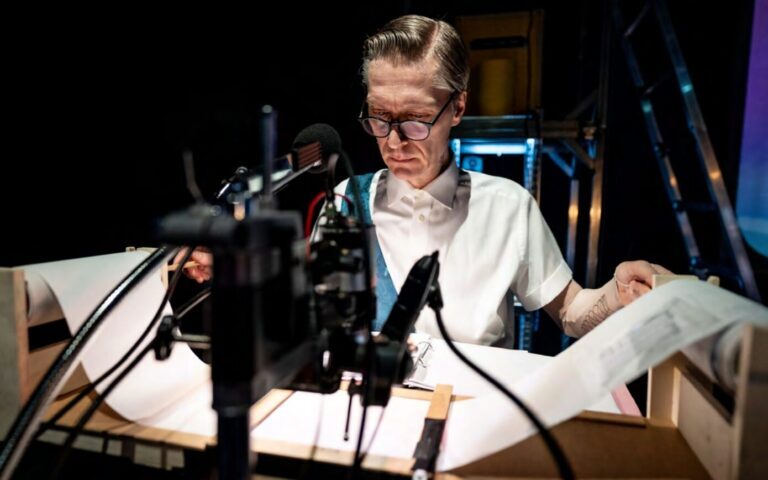
The Language of the Third Reich?, presented at FITS 2026, is built around the diaries of Victor Klemperer, but it does not function as a history lesson. Tore Vagn Lid is interested, rather, in the way the insidious mechanisms of dictatorship infiltrate the most ordinary details of everyday existence. His performance becomes a “theatre of emergency”, reaching far beyond the ambitions of a museum-like reconstruction of the past.
Travelling from Oslo to Sibiu, the performance enters a new field of resonance, when Western memory encounters the Romanian memory of authoritarianism and political double-speak, under the same sky of contemporary anxieties.
Andrei C. Șerban: In several of your projects, the spectator is not invited merely to watch a representation, but to enter a kind of critical space of listening. How can theatre make itself heard today, when other forms of public discourse, such as journalism, political analysis, or historical commentary, do not always succeed in generating real attention?
Tore Vagn Lid: For me, this is a question that occupies me fundamentally at the moment. In my latest production, “The Trigger System”, the problem is faced differently: in a completely dark theatre, and in the voice of perhaps Norway’s most iconic actor, he asks the audience if they really hope, and wish that he is actually there – present on stage, before – after several minutes – revealing that he really is. Hence the question of attention (and attention economics) rather becomes a question of trust, and of the longing of trust as a basic human condition.
And here is where I see a renewed potential of the analogue theatre which finds its quality precisely as a space for physical interpersonal communication in a time characterized by digital uncertainty, deepfake and post-factual manipulation. If I were to see the theatre’s space of opportunity in a time like the one you describe, it is precisely this quality of trust that gives the theatre a potential it hasn’t had in a long time. The theatre as a space for critical experience in this context can be essential. But that again depends on the theatre itself, its ability to reflect this potential in the very core of its forms and communication.
Andrei C. Șerban: On other occasions, you have mentioned that theatre is a “rehearsal for reality”, for situations that might arise. This idea also seems essential to The Language of the Third Reich?. How can theatre train the civic imagination to recognize danger before it becomes historical fact?
Tore Vagn Lid: Yes, that’s right. And I’ve even used, about my own work, the term theatre of emergency. Quite simply because I’ve seen the theatres potential as somehow a dress rehearsal for realities that realistically lie ahead of us in time. This is due to the theatre’s unique possibility for concentration, for reflection and emotions as one shared experience. Not as analytical, individual scenarios, reports, or academic hypotheses, but as real concrete situations, complex – both emotionally and intellectually. A turning point for me was my project “03.08.38 States of Emergency” as an attempt to reconstruct the afternoon of the right-wing terror attack in Oslo in July 2011. As for the “Language of the Third Reich?” this is exactly what motivates me: The possibility of going back in time in order to reach towards what perhaps lies before us. Not as an accurate mirror, but as a concrete political and existential comparison.
Andrei C. Șerban: Victor Klemperer’s diaries are unsettling because they place the violence of history alongside the “minor” details of everyday life, such as illness, money, music, marriage, fatigue, administrative humiliations, ordinary conversations. Why is it important to understand dictatorship not only through its major events, but also through its smallest domestic and linguistic infiltrations?
Tore Vagn Lid: A highly important quote from Viktor Klemperer’s diaries, is his remark from 1918, and from the so-called German Spartakist revolution or uprising. He writes that the poet who does not recognize that everyday life also characterizes the great worldwide disasters or events will always be lying. The undramatic of the historical drama, so to say! This becomes in a way a mantra for Klemperer’s own method throughout the horrible decades to come. And also, an important dramaturgic reminder or impulse in my own work.
In other words, holding on to an understanding of politics, not just as large, world-rushing movements, but as everyday life, individual relationships, small details, apparently trivial interpersonal relationships. Klemperer’s reminder, and I think a very central political reminder, is precisely that this is the “small” reality of “big” politics. The part of life where politics penetrates into people’s lives on the one hand, and – dialectically – reinforces itself as state or party politics on the other.
The dictatorial is therefore not just something outside and above, but something in the middle of everyday life. Something that stretches from the tiny swastikas printed on toothpaste tubes in the mid-1930s, to the specific rhetorical forms used by the radio operators of the Third Reich. That is why this “trivial” aspect is such an important reminder. Because it goes towards the very essence of politics.
Andrei C. Șerban: Your artistic practice moves between theatre, music, research, documentary, and political reflection, without turning the stage into a lecture. What does the creative laboratory of a performance such as The Language of the Third Reich? look like? How do diaries, philological observations, historical documents, musical structures, and the bodies of actors become a living theatrical composition?
Tore Vagn Lid: It is a question that may almost have to be answered from production to production, from project to project. But in general, I would say that this type of work not only uses the entire theatre apparatus with its diverse expertise, from actors to lighting design to sound engineering etc., but also uses a whole series of strategies normally associated more with academic research. For my own part, working also as a professor in dramaturgy at the Norwegian University of Science and Technology, I spend a lot of time on the systematization of sources, on translations, reflections on individual passages etc. So, it is a very extensive and time-consuming work that lies behind a project like “The language of the Third Reich?”.
And it is a way of working that blows the boundaries of what is often associated with traditional theatre work. It is also not possible to think of the dramaturgical composition in this production without thinking of the theatre as an expanded room for musicality, visuality, sociality. In my case the entrance to handling the massive diary material after Klemperer was not going through the dramaturgy of traditional Aristotelian drama, but rather to turn towards old musical-compositorial forms like the baroque suite, the chaconne, and the passacaglia.
And when I structure Klemperer’s diaries almost like a large, comprehensive score system with leit-motifs, its time axes and its different sounds, colours, it is due to dramaturgic necessity. But at the same time, this way of composing allows both actors and colleagues in the various artistic functions to have space, time and freedom in their own work.
Andrei C. Șerban: In a world of post-truth, artificially generated images, synthetic voices, and documents that can be fabricated more and more easily, documentary theatre seems to find itself in a paradoxical situation. On the one hand, the need for reality becomes more urgent than ever; on the other, the very idea of evidence and testimony becomes unstable. How do you see the future of documentary theatre in this new ecology of suspicion?
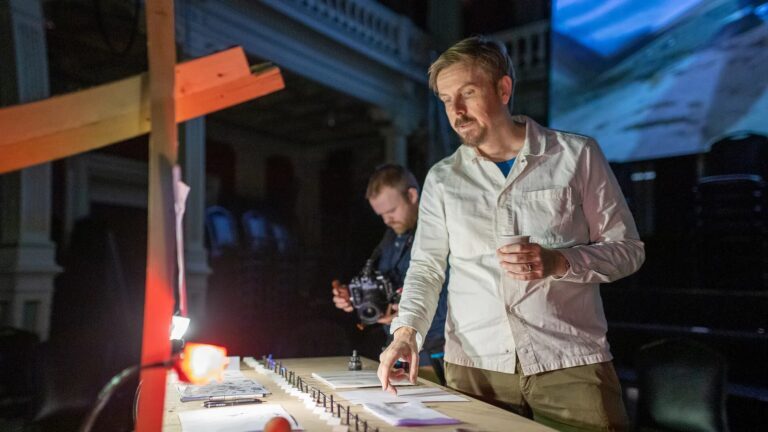
Tore Vagn Lid: I do not see my own artistic work as documentary in a strict sense, or as documentary theatre in a further sense. At the same time, I certainly see the problem linked to the truth in historical documents, etc. As for “The language of the Third Reich?”, this is almost paradoxically the opposite. Because the enormous documentary material that lies in the sources after Victor Klemperer has something unforged historical about it. Because the documents are from a time, and in a format before the digitalization with its extended potential for manipulation. For me as a director, what is here important on stage is a clear, open, and transparent negotiation with the historical documents. Not a kind of naive distanced objectivity, but rather the interpretations and negotiation itself as a transparent performative act.
The Language of the Third Reich? comes to FITS 2026, in Sibiu, to a festival space where different languages, cultures, and historical memories meet. It will be seen in Romania, in a region that carries its own memories of authoritarian language, ideological pressure, censorship, and political double-speak. What changes when this performance travels from Norway to Sibiu? Do you expect the performance to resonate differently in an Eastern European context?
Tore Vagn Lid: It is clear that the movement of a project like this, from Oslo to Sibiu, from a Norwegian historical context to a Romanian historical context, means a rather extensive dramaturgical shift. But at the same time, it is something I am really looking forward to trying out, and which I have genuine faith in. Both because I am aware of the dramatic Romanian history, refereeing here to the second world war-history and the cold war-period that comes afterwards, and because I am fundamentally interested in this type of shift of context for artistic works, and how they affect both the audience and those who work within the production itself.
At the same time, we are faced with similarities and not just differences. Both in Sibiu and Oslo we are more or less under the same historical sky when it comes down to the global political movements, the technological, information-related revolutions that takes place, and which radiates from – in this case – Silicon Valley and the US. So even though the context and the historical backdrop are fundamentally different, “The Language of the Third Reich?” should also here have something to tell, and some warnings to bring to the table.