Translation: Maria Strînbei
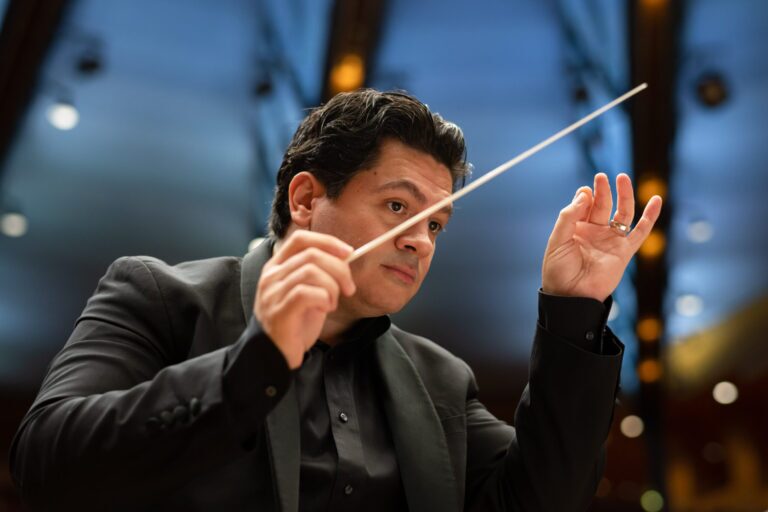
Cristian Măcelaru is one of the most acclaimed Romanian conductors, leading prestigious orchestras across Europe and the United States, and his name has become synonymous with artistic excellence.
He began his career as a violinist, becoming the youngest concertmaster in the history of the Miami Symphony Orchestra, which also made his debut at the renowned Carnegie Hall. As a conductor, he was awarded the 2012 Solti Foundation prize for Best Young Conductor. He is currently Music Director of the Orchestre National de France and the Cincinnati Symphony Orchestra and also serves as the youngest Artistic Director of the George Enescu International Festival and Competition.
Throughout a career distinguished by performances on the world’s leading stages, Măcelaru has received numerous accolades, including a Grammy Award for Best Classical Instrumental Solo Performance for an album featuring works by Wynton Marsalis, recorded with violinist Nicola Benedetti and the Philadelphia Symphony Orchestra. His recording of George Enescu’s complete symphonic works, conducted with Măcelaru’s baton, received multiple international distinctions, including the International Classical Music Awards (ICMA) in the Symphonic Music category, as well as the Classica“Choc de l’année 2024” and the Diapason d’Or.
At the 2026 edition of the Sibiu International Theatre Festival, Cristian Măcelaru will be awarded a star on the Walk of Fame and will conduct the opening concert alongside the Romanian Youth Orchestra and the Janoska Ensemble.
In preparing for my conversation with maestro Cristian Măcelaru, I was intrigued to discover that some online sources list 1981 as his year of birth, whilst others list 1980. He cleared it up himself, telling me that it wouldn’t have been too bad to be slightly younger; Cristian Măcelaru was born in 1980, in Timișoara.
Mr. Cristian Măcelaru, you started out at the Timișoara Music High School, coming from a family of 10 children, and you’ve gone on to perform on the world’s greatest stages. How did your passion for music begin?
I can’t say it was a decision I made myself, because as the youngest of ten children and with both my parents being great music lovers, naturally the decision to learn to play an instrument was made by my parents before I was old enough to make such decisions myself. One thing that’s actually quite bizarre, so to speak, is that I don’t know what it’s like not to know how to play the violin, because I learnt that before I could form memories.
While in university, I gave private violin lessons to support myself financially and found it very difficult. I had to rethink how I could explain to a child what playing a violin means, since I didn’t know how not knowing is like. It’s a really fascinating phenomenon; and as for music itself: I was surrounded by music from my mother’s womb, because everything in our home revolved around music. My parents were, as I said, great music lovers. My mother played the flute, my father played the piano and the accordion. There was always music in our family.
So you were the youngest. Did your other siblings have a musical inclination?
Absolutely: they all studied music. All ten of us studied at the Music High School. And then, after the Revolution, when it became possible for my siblings to continue their studies at university, seven out of the ten went on to the Conservatoire, and I think three or four of us went on to do a master’s degree in music. So we all have music studies.
You’ve already mentioned the violin. How did you make the transition from the instrument; why did you give up the violin in favour of the conductor’s baton?
It was actually a very natural transition: as the youngest boy in my family and the only son who played the violin, my father made me concertmaster of the amateur orchestra he conducted in Timișoara, in the church. I think I was 7 or 8 years old. I could barely play the violin, but he made me concertmaster just because he wanted me to be as close to him as possible, so he could keep an eye on me. And then that’s just how life happened, I think: for the rest of my life, wherever I played, I was concertmaster; in secondary school, at university, and then when I started my professional career in Miami, I was concertmaster for four years with the orchestra there. The transition from concertmaster to conductor is very natural, because the concertmaster, being the first violin, is in fact the conductor’s right-hand man; the whole orchestra looks at the conductor, but in fact they look very closely at the concertmaster. And I got comfortable with the idea of being the leader of an ensemble whilst sitting in the concertmaster’s chair.
But do you ever feel a sense of loss or nostalgia, for example when you worked with Anne-Sophie Mutter or with Nicola Benedetti on the recording that won you a Grammy? In other words, do you ever see yourself picking up the violin again?
Never, not in the slightest. The violin was limiting my ability to think about music on a macro level, that’s why I made the transition to conducting. I’ve always appreciated musical architecture and was very much in love with large musical forms, with symphonic works, and I was feeling very restricted playing the violin. What I wanted most when playing in an orchestra was to be the one making the necessary decisions and bringing to life a performance that truly captures the composer’s vision. You know, what the composer has written on paper is a bidimensional representation of dots on paper, but then it is the performer’s responsibility to transform the bidimensional representation into a multidimensional universe. And the decisions made to create that interpretation do not always reflect the composer’s intention.
Many performers alter what the composer wrote just to justify their own performance. And my philosophy has always been to present exactly what the composer wrote. That is what I do today, and it is precisely the reputation I have in the world of music. I always insist on bringing to life exactly what the composer intended. I felt deeply frustrated by the great liberties my fellow conductors had taken with the composer’s vision, so I was very keen to become a conductor and be the composer’s most ardent advocate.
I have read that you are described, and I quote, as “a champion of change and innovation in the world of music”, but also that, as you have just explained to me, you advocate the need to respect the composer’s intentions and the score. Are these contradictory ideas? Because, at first glance, there seems to be a slight contrast between innovation and a faithful rendition of the score. Could you elaborate on these two sides of you as a conductor?
First of all, I agree with the two points you made, and that is precisely what is so wonderful. The innovation I bring to the performance is to respect what the composer has written.
Interesting.
I don’t mean to criticize, but there was a tendency, especially in the second half of the 20th century, to make the performer the most important character. We no longer spoke of the composition, Mozart’s Symphony or Beethoven’s Symphony; it was Beethoven’s Symphony interpreted by X or Y. And so the composition became increasingly diluted, because young conductors naturally looked at what senior conductors were doing and took on what we call tradition. Tradition also developed back then, but this tradition arose from the conductor’s desire to be, first and foremost, slightly different; secondly, perhaps there were technical aspects that were very difficult to execute, and so we found all sorts of methods to make music a little more accessible for musicians to perform.
And I have discovered that when you stay as close as possible to the score and eliminate these traditions – not necessarily all of them, because there are traditions that are actually very necessary and intelligent – but when we eliminate the traditions that made music a little easier to perform, we are in fact reopening a whole universe of the composition itself in order to rediscover it. And this, to be honest, is an innovation, because what I do is not common in the music world. For me, that path, that in-depth journey to discover the composer’s intention and what they actually wrote, is in fact the discovery journey of the deepest beauty in music.
Speaking of tradition, tell me if you have a role model among conductors, and if there are works or composers that appeal to you more than others.
Every conductor is a role model for me. And I look at every conductor with admiration, because being one is such a difficult thing. Firstly, you must understand the music; secondly, you must truly believe that what you are communicating is truly authentic, and lastly you must be convincing in front of the ensemble, not through imposed but earned authority. You must possess the authority to convince the musicians to perform what you have conceived and imagined. The conductor is the only musician on stage who produces no sound. And for this reason, every conductor has something to offer in their own distinct style of conducting, and I learn from every conductor.
I can’t say that there is one particular conductor who has influenced me more or less than others. In different repertoires, there are conductors from whom I have learnt different things. Of course, I studied with a very famous conductor, Pierre Boulez, who influenced me greatly in the way I viewed architecture in music. I studied with Rafael Frühbeck de Burgos, who taught me a great deal about how to respect the musicians in my relationship with them on stage. I studied with a teacher in Houston, Larry Rachleff, who taught me how to communicate what I want to say to the orchestra, through gestures, through absolutely everything. That is why there are many conductors from whom I have borrowed a little of what they had to offer.
Do you have any favourite composers or works? Or ones that appeal to you more?
I have yet to meet a composer whose music I do not appreciate. Even when my first impression of a score is underwhelming, or when a composition does not initially resonate with me, studying it has invariably revealed qualities that make it as compelling to me as any of my favourite works.
What draws me most deeply to music is the act of creation itself. The composers I cherish most are those who communicate that creative impulse most profoundly. Enescu, Mahler, Brahms, Stravinsky, Bartók, Ravel, Debussy — I could never choose between them. In fact, the more composers I name, the longer the list becomes.
Each composer has a unique role in shaping the intricate universe of music. I see musical creation as a kind of infinite column to which every composer contributes a brick. Remove even a single one of those bricks, and the column would no longer be complete. Every composer adds something essential, something that could come from no one else. That, to me, is the beauty of it.
What is the most important piece of advice you would give to a young person who wants to pursue a career in music?
To find a way to listen to a great deal of music, not to form preconceptions too early, and to be open to absolutely every possibility. Of course, there are traditions and teachers who try to guide children along a path that is as clearly defined as possible. But, in fact, the beauty of music reveals itself when we do not know what we are looking for. It is only when you are free of preconceptions that the window of opportunity opens at its widest. I was always the student and schoolboy who said ‘yes’ to every invitation, to every tip, especially when I was younger. I was always open to reading a new composition, to playing in a recital to help a colleague, to listening to a new score. I always said ‘yes’, I never said ‘no’. And this taught me that, in order to truly discover the beauty of music and to delve as deeply as possible into the music itself, you must have an open mind and an open heart to receive it. This is the most important thing.
How important is the audience at a concert?
It’s very important. It brings the energy needed to inspire us musicians to play at our very best. During the pandemic I conducted many concerts without an audience, which was very, very difficult. I learnt that, in fact, the value of the audience is perhaps not quite as important as that of the musicians on stage, but its energy during a concert is. It is, in fact, the essential ingredient to a truly memorable concert.
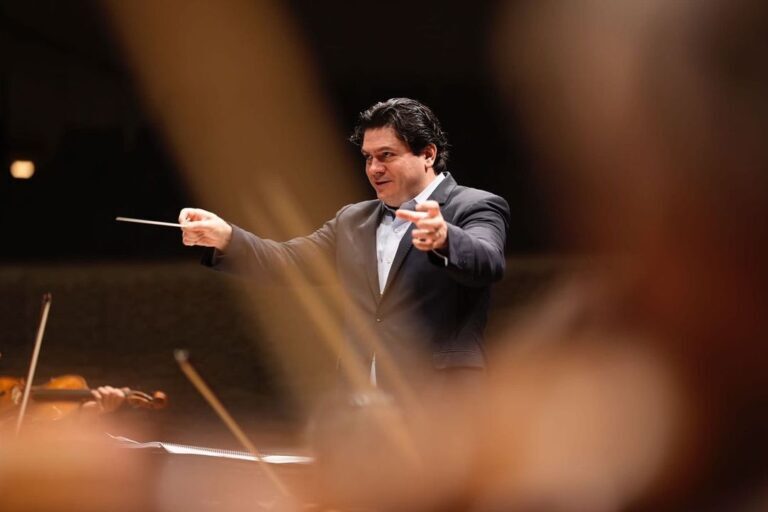
You will receive a star on the Walk of Fame during Sibiu International Theatre Festival, which you’re attending in June. I haven’t asked whether the awards—the major ones, the many you’ve received throughout your career—have changed you. But I would like to ask: do you feel like a celebrity, Mr Măcelaru?
That’s a very good question, because I’m not sure how a celebrity is supposed to feel. So I don’t really know whether I feel like one. What I can tell you is that whenever I’m at an airport or on a plane and someone approaches me and says, “Are you Maestro Măcelaru?”, I immediately feel a connection with that person. People come up to tell me they enjoyed a concert I conducted, or that they saw me on television and that it brought joy to their lives.
The fact that the concerts I conduct and the events I’m involved in can bring happiness to people is deeply moving to me. It always reminds me how privileged I am to be able to do this. If that is what fame means, then it is something very beautiful.
Of course, there are moments when I’m at an airport or on a plane and don’t particularly feel like talking to anyone. But that feeling vanishes the instant someone comes up and says, “Maestro, could I have a picture with you? I so admire the way you conduct.” That is genuinely and overwhelmingly heartwarming.
So yes, if that is what fame means, then I’m happy to embrace it.
This year’s Sibiu International Theatre Festival’s theme is SOUL. So I’ll ask you: what does Cristian Măcelaru put his heart and soul into, what is worth putting your heart and soul into?
I believe we should put our heart and soul into everything we do. From the way we say “Good morning” to a neighbour, to the way we walk down the street and interact with the people we meet, everything should be done with care and love. It is the only way we can transform the society in which we live—a society from which we ourselves directly benefit. A society built on these values becomes more beautiful, more welcoming, and ultimately more humane.
To me, this is the essence of a good life, because we depend so much on one another. Perhaps this is the lesson I have learnt most clearly through music. Every musician depends on every other musician. I often tell the orchestras I conduct that building a better orchestra and achieving greater artistic excellence is not simply a matter of each individual playing as well as possible. Rather, it is about every member of the orchestra helping their colleagues perform to the very best of their abilities.
When we embrace this mindset, we create not only a stronger orchestra but, metaphorically, a better society—one in which each person helps their neighbour and colleague become the best version of themselves. That requires heart. It requires love, patience, and generosity.
These are precisely the values that George Enescu embodied throughout his life. Beyond being a remarkable musician, he was a man of extraordinary kindness and generosity. He taught, mentored, and supported those around him, and that legacy endures to this day.
Over the years, I have spent a great deal of time studying and learning about Enescu, yet I have never come across a single story that reflects poorly on him. No one ever seems to have spoken ill of him. He was, by all accounts, a genuinely gentle, compassionate, and loving human being.
What would you have liked to become if you hadn’t become a musician or a conductor?
An architect.
Do you have any rituals or superstitions before a concert? Something you always do intentionally before every concert.
I really don’t have anything at all, but the reason I don’t have any rituals is because I want to avoid the idea of creating a ritual that might then limit me. You have to remain open to all possibilities, and a life where I travel every week doesn’t allow me to create a ritual because you never know what circumstances you’ll find yourself in. I actually wrote an article for the New York Times in which I wondered whether the very idea of eliminating a ritual, of not creating a ritual, might become a ritual in itself? So I’m so focused on the idea of not creating a ritual that it’s possible that idea itself might become the ritual.
What sort of music do you listen to, if any, other than classical music for strictly professional reasons?
I listen to all sorts of music and absolutely all interests me, because, in fact, the way music communicates is what fascinates me. My children, who are 13 and 15, are always keeping me on track with what’s currently popular: new artists, new singers, new bands.
Do you ever complain about the music they listen to?
No, because, to be honest, perhaps I’ve been lucky so far, but they haven’t yet shown me anything that isn’t interesting. Yes, perhaps they have very good taste, I don’t know. It’s true that I prefer music that conveys an uplifting message, not one that actually undermines a person’s integrity. That’s why I don’t listen to music that talks about women in a way that’s…
Defamatory.
Exactly. That is something neither I nor my family can accept. So perhaps that is why I’m not particularly drawn to rap music—not because I dislike it as a musical genre, but because I often disagree with the values and attitudes reflected in some of its lyrics.
But is there a band from your youth, a group you’ve stuck with since your teenage years?
When I was a teenager, and perhaps until I had children, I didn’t really listen to anything other than classical or jazz. I grew up listening to a lot of jazz. I remember my classmates listening to all sorts of things – Guns N’ Roses and all sorts of famous bands, the Beatles, for example. But my horizons didn’t broaden in that direction. When I was young, I was actually very, very obsessed with classical music. I mean, I was in a very narrow, well-defined tunnel. The older I get, the wider my horizons become.
Thanks to your children?
Thanks to my children, yes.
What do you think about artificial intelligence in music?
I think the name itself defines exactly what I think. It’s artificial.
It has no soul.
Music must be a creation that expresses what a human being, a person, wants to say. Even if the two are quite comparable—that is, a human composer also takes everything they know, what they have learnt from the universe, from the wider world, and then create something with that—AI follows the same idea, but it is all artificial. It lacks that soul, that emotion which is essential for transforming sounds into art. Music must become that means of communication, especially when we’re talking about composition. For me, AI will always remain artificial, because it isn’t something born out of a human’s desire to communicate something.
What can we expect from the FITS opening concert?
It will be a ‘Beyond Classics’ concert that goes beyond what the famous composers we know and love have given us. The Janoska Ensemble, which is coming to perform alongside the Romanian Youth Orchestra, is an extraordinary ensemble; they are musicians formed by the Vienna Conservatory and have played in the Vienna Philharmonic. So they are extraordinary musicians, but they have a slightly different perspective. They combine what we know and recognise from the music of Brahms or Bartók with the idea of a contemporary reimagining featuring improvisations, with elements that are a little out of the ordinary, yet very, very sophisticated, and I believe it will be a great success.
Thank you so much!
Cover image: © Adriane White