Interview with Elise Wilk
She believes in the specific human need to listen and tell stories and envisions the dramatic text as an architectural project or as a score, in which each character has its own voice.
Elise Wilk has earned a well-deserved place in the landscape of contemporary European dramaturgy through the numerous productions of her texts, both in Romania and abroad (Germany, Austria, France, Switzerland, Italy, Greece, Bulgaria, Hungary, Cyprus, Georgia, Russia) and through the awards she has won. She was born in Brasov and graduated from the Faculty of Journalism (Babeș-Bolyai University, Cluj). Since 2020 he has a PhD in Theatre from the University of Arts in Târgu Mureș, where he currently teaches dramatic writing.

In 2008, her first dramatic text, It Happened on a Thursday, was among the DramAcum5 laureates. Since then, her plays have been translated into 13 languages and won awards both in Romania and abroad, the most important being the Aurora Prize for Eastern European Drama awarded in 2022 in Poland for the play Disappearances.
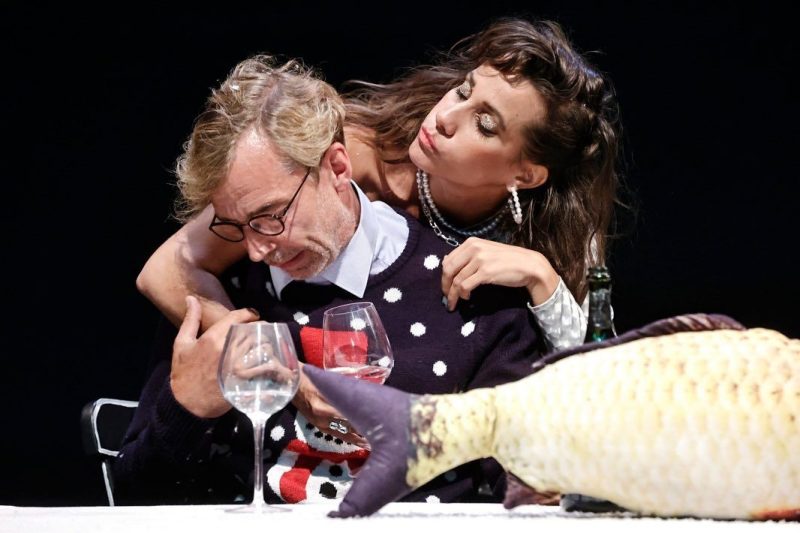
Anda Ionaș: The National Theatre of Timisoara opened this autumn’s season with a premiere performance of Union Place, a co-production Austria-Luxembourg-Romania. You wrote the text for the show especially for this meeting between theatres. Were you asked to link the subject to the idea of the cultural capital, or were you free to choose?
Elise Wilk: The project was proposed to me by the Schauspielhaus Salzburg in Austria. They then searched, through the European Theatre Convention (ETC) network, for partners in Europe for this project. Besides Luxembourg, they really wanted a co-production with Romania and decided on the National Theatre of Timișoara.
I knew from the beginning that I would have to write a text in three languages (Romanian, German, English) that would take place in the three European countries involved in the project. The title Union Place was initially a working title proposed by Robert Pienz, the director of the Salzburg theatre, who started from the idea that in almost every large European city there is a Union Square.
So the „assignmentˮ I received was to write three stories set in different parts of Europe and to think about the idea of unity in diversity. Interestingly, a year ago at this time, when the text was not yet written, I already knew the cast, i.e. I was shown the photos of the actors who would be part of the project. I wrote the text thinking of suitable roles for them and so that the three parts would not have actors from the same country. I thought that by acting with a colleague from another country they would have much more to learn from the project.
But did you already have the story in mind?
Elise Wilk: No. The cast was made in advance because we needed actors willing to travel and spend a lot of time in rehearsals and performances abroad. So I wrote for these actors. It’s just that by the time rehearsals started, some of the cast had changed because some actors were no longer available for the project due to health reasons. Some of them were no longer age-appropriate for the roles. At first I was worried, but then I realised that that’s the beauty of projects like this: adapting to the unpredictable.
It’s very interesting that these kinds of constraints sometimes make you want to be more creative, because it’s not easy, I imagine, to have a cast already made up and to think of stories strictly for those actors.
Elise Wilk: Always when I knew the cast in advance it was easy to write. I’m convinced that if I had been given the cast a year ago, I would have written a completely different script.

How did you start writing and why did you choose theatre? Given that your plays have a lot of lyricism, the characters use a lot of monologue to share deep personal experiences, I think you might as well have turned to prose, to first person narrative.
Elise Wilk: I started early, about eight years old, mostly poetry and prose. If anyone asked me what I wanted to be when I grew up, I’d say writer. Later, in high school, because I was in a theatre group, I discovered playwriting. I fell in love with the plays of Dürrenmatt and Ionesco, which we staged, and I wrote my first play – I was 15 – obviously inspired a lot by the authors mentioned above.
I knew then that this was the direction I wanted to go in. I’d love to write a novel one day, but I’m aware that I need more time and respite for that. It’s a much more solitary occupation than writing for the theatre and I think it requires more isolation. I don’t think a novel can be written “in bits and pieces”, one page today, another page two weeks later. Or at least I don’t work that way. And when I have a play to write, I try to write constantly, almost every day. If I’m always interrupting myself, there’s no way anything good can come out. The novel will come sometime, hopefully in the next 3-4 years.

In theatre I like the fact that you get direct feedback from the audience. I find that I learn a lot when I see performances based on my own texts. Then, through audience feedback, I can see what works well and what doesn’t. When you’re writing prose, you don’t really get to see your readers put the book aside because they’re bored. Or, conversely, how they stay up all night reading because they find it so exciting.
Most of your texts are about adolescence. Why? Do you resonate more with this age?
Elise Wilk: I think the texts about adolescence represent only a third of what I’ve written so far. In fact my first texts written in 2008-2010 (which, surprisingly, are still being played out) were not about teenagers. After I wrote The Green Cat, which absolutely coincidentally was a text about teenagers (I was supposed to write for very young actors), and I saw what an impact it had, I realised how much the audience needed performances about young people and I continued, for a few years, in this direction, which I was very interested in.

It was a phase that ended 3 years ago with my doctoral thesis on theatre for young audiences in Romania. As far as drama is concerned, my areas of interest have not been there for about 5 years. I hope I have opened a way for other, younger playwrights to write about teenagers. For now I feel I have nothing more to say in this area, my interests are now different and I want to talk about other things.
Do you have a particular type of viewer in mind when you write? Do you think, for example, in the case of texts for teenagers, how they would find themselves in the story?
Elise Wilk: I’ve never written “for teenagers”. Even when it was for teenagers, the audience for the shows was pretty much all ages, because it seems to me that parents, teachers, people who remember their high school years can resonate with these subjects. I don’t have an ideal audience in mind, because certain things can resonate differently with different people. Rather, I think of myself as the viewer and write things that I would like to see in the theatre.

As a playwright, you write a play, you imagine a world of characters and that world is then recreated by a director. Have you experienced the frustration of not seeing certain key elements captured in the staging? Or perhaps, on the contrary, did you find that the performance comes with new accents that enhance your creation?
Elise Wilk: I like the element of surprise most in writing for theatre – when the director sees things in your text that you haven’t even thought of and puts new layers on top of what you’ve created. Obviously, there are unpleasant surprises. It has happened to me that the director doesn’t actually understand the text, it has even happened to me that he has changed the structure, taken out of context certain lines that then appear on stage completely different from what I wrote, or completely dropped the humour.
It’s quite painful, because then on stage it’s not your play anymore, it’s just a performance in which the text is used as a pretext to serve the so-called “directorial vision”. Precisely because of the fear that their texts are presented in a completely different way than they imagined, there are playwrights who direct them themselves. I wouldn’t want to do that. I don’t have a directing degree and I’m not interested in it – that’s why I write theatre, for the surprise, to see how someone else turns what I’ve imagined into reality.
Besides, I like the fact that a text can be staged in many different ways. I’ve seen some very different stagings of the same text that I wrote, but which, although different, respected the text. Some brought out the humour, some the poetry, some were a combination of the two.

How do you create your characters? Are you inspired by people you know?
Elise Wilk: I think every character borrows some things from people I know, people I’ve seen, but also from me. It’s never 100% someone I know, but it may borrow more or less certain traits or characteristics. But yes, I think if you’re writing for theatre you have to be very aware of what’s going on around you, be a good observer. That’s what I tell my students. I ask them, “Do you, when you ride the bus or the train, look at the people around you and imagine what their story is? “ˮIf so, then they have the potential to be playwrights. I think if you look around with curiosity, you can see a lot of things that can inspire you.
Your characters are very fragile, sensitive, they have something special… And they speak very honestly about their own emotions and traumas… Do you usually research psychology before writing?
Elise Wilk: I haven’t read much psychology books, but indeed, even in the show Union Place, a critic from Austria noticed things that I hadn’t even thought of: namely some childhood traumas of some characters and some ways in which parents behaved, which then spilled over to the children, but it wasn’t intentional. I think it’s useful to read psychology books, but I don’t think you have to bring that to the stage. I’ve seen shows where the characters talk like they’re in psychology treatises, and I don’t think a show has to be a psychology lesson.
Do directors generally invite you to see the show while they are working on it? Can you intervene?
Elise Wilk: If it’s a commissioned text that’s being staged for the first time, I usually try to get to the first readings. I think it’s especially helpful for actors who have questions or concerns about the characters they’re about to play. If it’s a second or third staging, I usually don’t go much further. I mean, I go to see the show, but the proposal to dictate during rehearsals doesn’t come up. For example, at Union Place I talked a lot with director Alexandru Weinberger Bara while I was writing, and then I went to Austria for the first readings. There were some questions from the actors there, because although the distance in kilometres between the two countries is not great, there are some cultural differences. Certain things that were absolutely obvious to actors in Romania had to be explained to those in Austria or Luxembourg. So I had to be there at the beginning.
I was very impressed by the story of Mariana and Rudi, a Romanian citizen but ethnic German, who flees to Germany before the 1989 Revolution.
Elise Wilk: It was clear to me from the start that there would be a part that takes place in Austria, another in Luxembourg and a third in Romania, more precisely in Timișoara. And for the Timișoara episode it seemed very appropriate to write a story that was right there – the story of a border crossing before 1989. In the text it says that Rudi, who fled to the West in 1986, wrote to his girlfriend in the Padinska Skela camp. At the Salzburg premiere, there was a man in the audience who was 17 when he fled the country in 1986, exactly the same age as the character, and who told me that he had spent some time in Padinska Skela. I think it’s a story that many people from Timișoara found themselves in.
You yourself come from a mixed Romanian-German family. To what extent do you think this has impacted your artistic creation?
Elise Wilk: I think if I hadn’t read so many children’s books from my uncle in Germany and listened to so many story tapes, I wouldn’t have wanted to write myself. In fact, the first time I wrote fiction, I wrote in German. At that time there were not so many children’s books in Romanian. So in Romanian I read what I could find. I remember that during a holiday in the countryside, when I was in the second grade, I read Otilia’s Enigma and I liked it a lot.
I have the advantage of living in both cultures and that enriches you. I usually write in Romanian because I live in Romania and write for theatres here. In German, my plays are usually translated by someone else. But I also collaborate with German theatres. The German language parts of Union Place (i.e. about 60% of the text) are written directly in German and I found that extraordinary.

What do you think are the biggest challenges a playwright in Romania has to face at the moment and what positive changes do you think are needed in the cultural sector to encourage young people who want to write drama?
Elise Wilk: Let’s start with the good things. Ten years ago there was not so much interest in Romanian contemporary drama. Today, state theatres and many festivals organise playwriting workshops, there are more and more reading performances with new Romanian texts, there are mentoring projects (emerging authors are accompanied in the creative process by experienced playwrights), there are more and more directors interested in working with local playwrights. And in the repertoires of state theatres we find more and more new Romanian texts.
However, the playwright seems not to be taken fully seriously. There are still few theatres that first invite the playwright to write a text and then look for the right director to stage this text. Most of the time, it is the director who is invited, and the director in turn recommends a playwright they want to work with.
I think more validation and recognition is needed. For example, in Germany there is a huge investment in playwrights. There are hundreds, maybe even thousands of residencies where they can apply to write quietly, city halls offer creative fellowships, theatres invite one of their own playwrights for a season to assist in the creative process of the performance and write a text for the theatre, and there are thousands of projects to encourage writing that start at school. The German space could be an example to follow, but some things are difficult to implement here. For example, there are very few residencies here. But if there were – I don’t know how many playwrights would be able to take three months off to write in a seaside villa. Most of us are also employed (yes, you can make a living from writing, but it’s far too risky to freelance in Romania). Ten years ago I was working as PR in a corporation and I wouldn’t dare dream of attending the rehearsals of a show, not even the first reading. I wasn’t even allowed to go to a premiere. Things are different now and I’m much more flexible, but back then it would have been impossible for me to work in a collaborative process on stage, for example. And I’m sure there are many people in that situation.
Changes are needed and I believe that Romanian drama needs more contexts in which to develop. Young people should benefit from these contexts from a very early age. They can be created by theatres in close cooperation with schools. I believe that without a consistent programme for young audiences, you cannot attract children and teenagers to writing. A good show is not enough. Theatres need to hire theatre educators, there needs to be serious partnerships between schools and theatres (not just filling the halls with students), training for teachers so that the experience during the performance is deepened. If a kid likes a show and finds out that someone wrote the script for that show and that it’s cool to write theatre, maybe they’ll give it a try. How can a young person want to write theatre if they’ve never seen a show that fascinates them?
This journalistic material was made possible by a grant from Energie! Creative Fellowships, granted by the Municipality of Timișoara, through the Project Centre, within the Power Station component of the National Cultural Programme “Timișoara – European Capital of Culture in 2023”. The material does not necessarily represent the position of the Timisoara City Projects Centre and the Centre is not responsible for its content or how it may be used.

Cover photo: A. Bordeianu