The National Theatre of Timișoara opened the 2023-2024 season with a theatrical co-production in which Schauspielhaus Salzburg and the Esch Theatre of Luxembourg were partners. It is “Union Place (A short trilogy)”, directed by Alexandru Weinberger-Bara, on a text specially written by Elise Wilk. It premiered on 25 May in Salzburg, on 25, 26, 27 and 28 August it was presented in Timișoara, and on 20 and 21 October it will travel to Luxembourg, which last year held the title of European Capital of Culture.

The text, written in Romanian, German and English, reconstructs three life stories, like a jigsaw puzzle, based on sequences from the present or the past, with the common theme of migration. Elise Wilk shows a very fine sense of observation of people and their depths of soul, a good anchorage in the present through the subjects chosen, a realistic view in the presentation of the facts and the interaction between the characters.
Vienna, Timișoara and Luxembourg become landmarks in the biographies of the protagonists. Travelling outside the borders of their country is a transformative experience, allowing them to escape from the problems, discontent and frustrations they face in their current existence, but at the same time offering them new challenges.
At the airport in Vienna, Sophie meets young Darius, with whom she begins an extramarital affair. He makes her feel young and wanted and makes her think less about her biological clock and the fact that she hasn’t managed to have a baby yet.
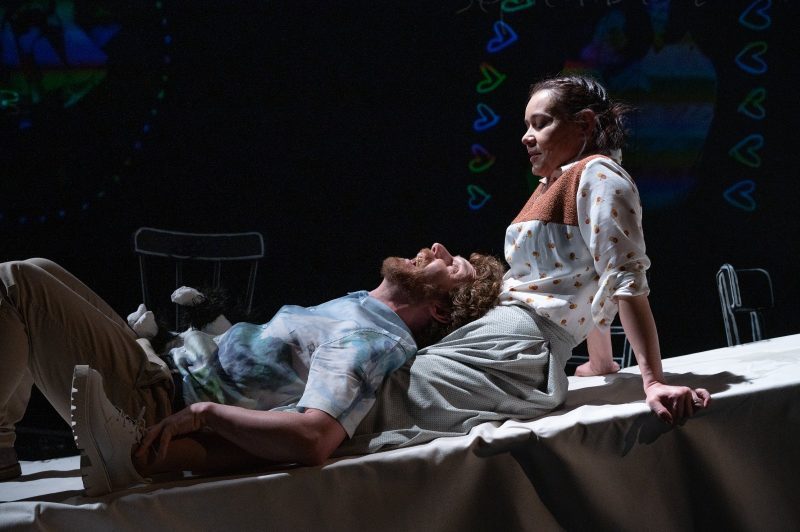
In Luxembourg, Daniela celebrates Christmas with her husband, the German intellectual Walter, who is much older than her. She has never loved him. Instead, she was attracted to the security and material comfort he could offer her. Poverty in Romania had long ago driven her to seek her fortune abroad, leaving her young child in his father’s care.

In Timișoara, Mariana and Rudolf, who had formed a couple in their teens, meet after many years. Unable to bear the constraints and abuses of the communist regime, Rudolf fled Romania on New Year’s Eve. He had wanted to take his girlfriend with him, but close family ties and fear of the unknown led the girl to give up at the last minute. The three couples seemingly have nothing in common, but in reality, through unseen threads and undisclosed secrets, their lives are interconnected.

Another important theme, along with migration, is the parent-child relationship. Sophie wants a child so badly that she and her husband decide to pay a Ukrainian surrogate to carry their child. But life throws her an unexpected surprise: she becomes pregnant with young Darius. Daniela has a son in Romania whom she tried to give a carefree childhood by working hard abroad, but failed to give him love and attention. Her husband, Walter, also has a daughter from a previous marriage, none other than Sophie, who can’t stand her father’s new wife, which causes her great frustration. Rudolf, back in the country after many years, is looking for his long-time girlfriend, Mariana, precisely because he has found out that he has a 36-year-old son with her, whom he has never met. The news comes at a time when the boy he had with his wife had died in a tram accident. Nothing can compensate for the pain of loss, but the idea that somewhere in Romania he still has a son drives him to go in search of him. Mariana has refused to talk about the past all these years. Not even the family he started after Rudolf left the country knows this secret. In a communist country with a conservative mentality, an out-of-wedlock pregnancy was a disgrace, and in order not to find out, her parents had sent her to an aunt in Bucharest to give birth, and the child was given up for adoption.
The stories are fragmented, but they interweave, forming a web, a complex fabric, as scenes from the past are juxtaposed with scenes from the present and different cities in Europe are brought together by shared human experiences.

The minimalist set, designed by Isabel Graf, is composed of three tables, which together form a single large table, suggesting both the connection of the stories to each other and the collaboration between the three theatres in the making of the project. In the background is a blackboard on which the names of the protagonists and the year in which the action takes place are noted throughout the performance. The background of the characters is also reflected in their attire, especially for the women. Marianne’s demure blouse with ruffles and polka dots, midi skirt and braided hair are typical of a modest girl brought up in communism. Danie’s tight, sparkly dress and big earrings can be associated with the festive moment of Christmas, but also with her attraction to the world of showbiz, her aspiration to become a famous singer. In dress and hairstyle Sophie gives the image of a confident middle-aged woman. At the opposite pole, Darius, with whom she is having an affair, appears at one point dressed in a bunny suit, expressing immaturity, the need to be more childlike. In fact, the relationship between the two is based precisely on this exchange: with him she feels younger, while for him she is a substitute for his mother.
The complex characters are played with talent and expressiveness by a mixed cast speaking three languages: Romanian, German and English. As a text performance, through dialogue the hidden traumas and sufferings are gradually revealed, exposing appearances. Darius is an architecture student, but in reality the university was chosen for him by his parents, who always put pressure on him to follow a path that was not his. In an unconscious attempt to evade their expectations, he tends to break out of the mould, forging documents and having an affair with an older, married woman. Sophie has a good financial situation and a husband she pretends to love, but in reality she is cheating on him with Darius.

Apparently Walter and Daniela are a successful couple, without material worries, with many friends. In reality, Daniela has accumulated a lot of unhappiness over the years, especially about her unfulfilled career and her unfulfilled role as a mother. This is why she gossips about her friends and rages at her husband, his daughter and the father of her child.
At first glance, both Mariana and Rudolf are happy in the families they have created for themselves after their separation, but as the discussion progresses, we discover that each has experienced dramas that the other knew nothing about. Rudolf’s highly polished shoes are not due to a very caring and loving wife, as Mariana believes, but to one who compulsively cleans them as a form of stress relief from the death of her son. For her part, Mariana, although she has a beautiful family, has suffered greatly from her separation from Rudolf and the rape she was subjected to by a grenadier the night he fled Romania. Their past love is evoked through the music of Gică Petrescu, playing in the Căprioara café.
A very interesting directorial choice is to put the characters in the situation of communicating in different languages, thus suggesting the possibility of establishing a dialogue between cultures, beyond the inherent differences.
In Alexandru Weinberger-Bara’s performance, the theme of crossing borders, the mixed cast, the multilingualism, the mobility of the set all converge towards the construction of a coherent vision, suggesting the unity in diversity of Europe, belonging to the same cultural space and a common history.
Union Place – A short trilogy
by Elise Wilk
Artistic Director: Alexandru Weinberger-Bara
Cast: Andrei Chifu (Alex), Sophia Fischbacher (Daniela), Wolfgang Kandler (Rudolf), Cristina König (Mariana), Jens Ole Schmieder (Walter), Philippe Thelen (Darius), Christiane Warnecke (Sophie)
Set design: Isabel Graf
Music: Georg Brenner
Lighting design: Marcel Busá
Dramaturgie: Jérôme Junod
This journalistic material was made possible by a grant from Energie! Creative Fellowships, granted by the Municipality of Timișoara, through the Project Centre, within the Power Station component of the National Cultural Programme “Timișoara – European Capital of Culture in 2023”. The material does not necessarily represent the position of the Timisoara City Projects Centre and the Centre is not responsible for its content or how it may be used.

The cover image belongs to Adrian Piclisan.