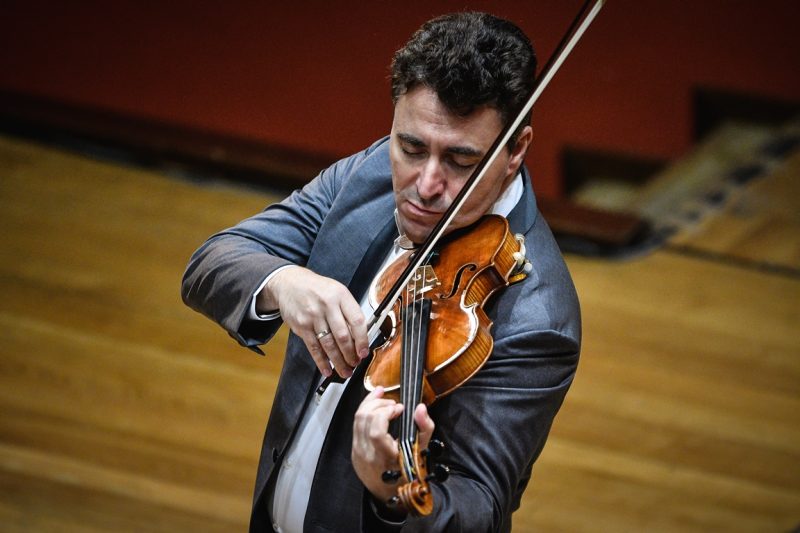
‘Every time I play, I am transposed into another world. Music charms me completely’, says Maxim Vengerov. For him, music is like a planet. This pleasure for playing is conveyed through every musical note and seems to have an impact on each and every spectator. Even when you sit on the last but one row, you get the feeling he only plays for you. There’s no need for big, pretentious words to describe him. You can only admire his talent and modesty, and tell yourself: ‘What a man, what a musician!’
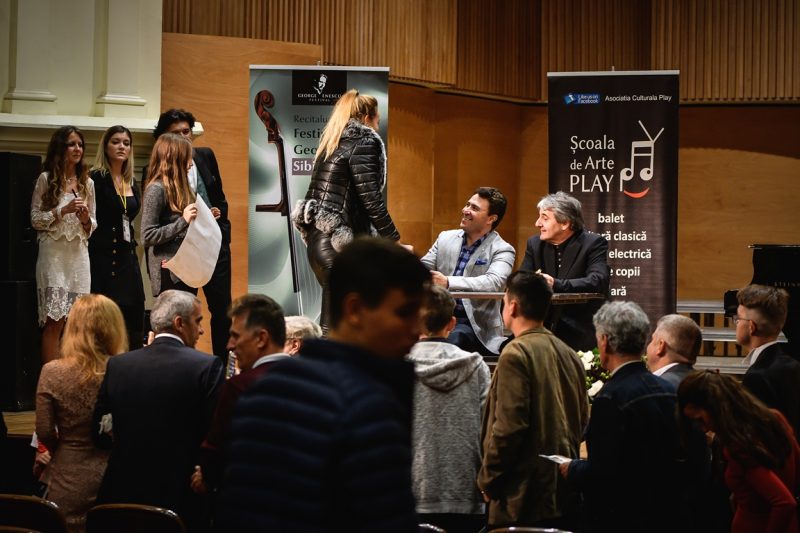
In Sibiu, the audience was generous to Vengerov. But still, the musician seemed even more generous, as, after a two-hour recital, he returned to the stage again and again to sing another encore, and then another one… And at the end, he sat on a chair and gave autographs to everyone who waited for him for 20 minutes after the concert.
What is the connection between Maxim Vengerov and Romania? The answer is George Enescu, his childhood idol. This is why we, spectators, are fortunate. Due to Enescu and the festival carrying his name. It gave us the opportunity to see and listen to great world artists performing on Romanian stages, and to listen to Maxim Vengerov playing Enescu’s Sonata No. 2 on the stage of the Sibiu Thalia Hall. After almost three hours on stage, he still had the patience to answer some of my questions.
This is not the first time you are playing in Romania, but, this year, it was the first time you played one of Enescu’s works, Sonata No. 2 for violin and piano. What was the study process like in this case?
Maxim Vengerov: I have always wanted to study Enescu’s music. I think his works are not only extraordinary, but they are also very well composed for violin. When you play sonatas by Beethoven or Brahms, of course you like them because they are extraordinary music pieces, but they were not composed by a violinist. Enescu is a combination of both worlds, an amazing composer who wrote wonderful pieces for strings. I think this brings added value to his work. Also, when you play sonatas like Sonata No. 2, you can feel how Enescu saw his future symphonies. Although created when he was an aspiring young man, this sonata is indeed a jewel and should be played more often.
Will you add this sonata to your repertory and your concerts all over the world?
Maxim Vengerov: I have already done so. I will even play it in Paris at the end of the month. I hope one day, pretty soon, I will also get to study Enescu’s Sonata No. 3.
Besides your well-known career as a violinist, you are also a conductor. What is this combination like?
Maxim Vengerov: For me, George Enescu is the best example of a musician. He was as good a conductor, as he was a violinist and pianist. He started his conducting career quite late, around 40. This only demonstrates he was a true genius, for, in only a few years, he became a very good candidate for the principal conductor position at the New York Philharmonic. So, he was truly versatile. He turned any task to gold. This applied to teaching, too. Thinking about the 20th century generation, I think Enescu is one of the best examples for young violinists.
What keeps you enthusiastic about playing further and about exploring different styles?
Maxim Vengerov: The love I have for music, the passion and communication, the relationship that music enables me to establish with people. When you play such recitals, for two hours, you establish a communication with the people in the concert hall. You can talk to them through music, which I think is a gift, and a real blessing to be able to travel and sing to people all over the world.
How important is the audience in this whole process?
Maxim Vengerov: The audience is the main reason I play. I don’t like playing all by myself. Even though some musicians don’t agree, this is how I feel. I’ve always wanted to play for people.
Photo credits: Dragoș Dumitru
English Translation: Irina Vîlciu